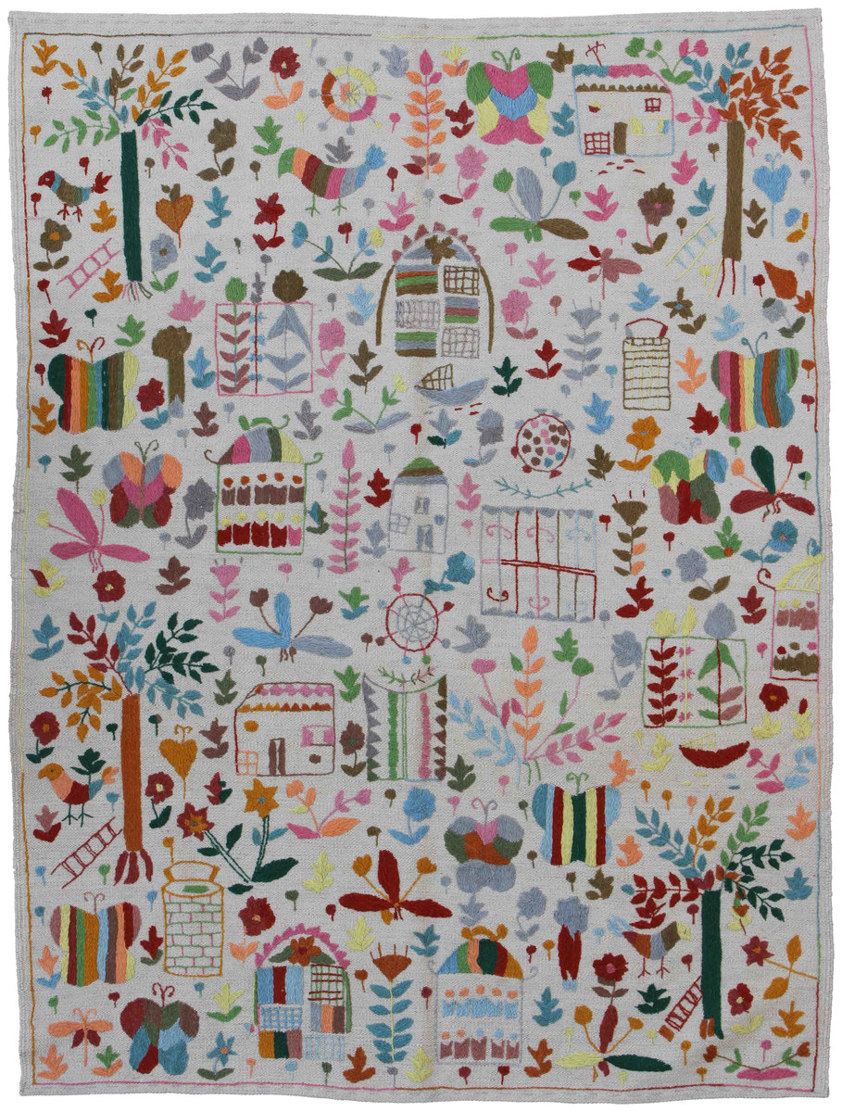
Colourful panels appear among the trees and flowers on this rug, their interiors divided into tiny squares, stripes or upright plant forms. Rounded butterflies add broader paired shapes. Small birds, wheels and little ladder-like marks occupy the gaps, with pink, blue, green, yellow and orange distributed throughout the pale field. A few darker leaves give selected trees a stronger outline. In a small study or bedroom, the 192 × 145 cm format would offer detailed colour without requiring a large open floor.
A plain chair would leave the little subjects visible nearby, and a single blue or pink object could connect with one part of the drawing. The narrow perimeter remains secondary to the pictorial field. The history associated with Suzani is centred on domestic embroidery in Central Asia. Uzbek and Tajik communities produced decorated household covers and hangings, and such textiles could have a place in marriage preparations. Botanical ornament formed an important part of their vocabulary.
This Afghan kilim gives that wider decorative reference a miniature garden setting, placing fine plant stems beside much more solid little structures. The drawing shifts repeatedly between outline and filled colour. A gridded panel can remain light within, while a broad wing carries several adjacent blocks of colour. Trees provide taller shapes at the sides, and smaller flowers make the intervening ground active. These differences offer a close view that is more varied than the general scattering of colour first suggests.