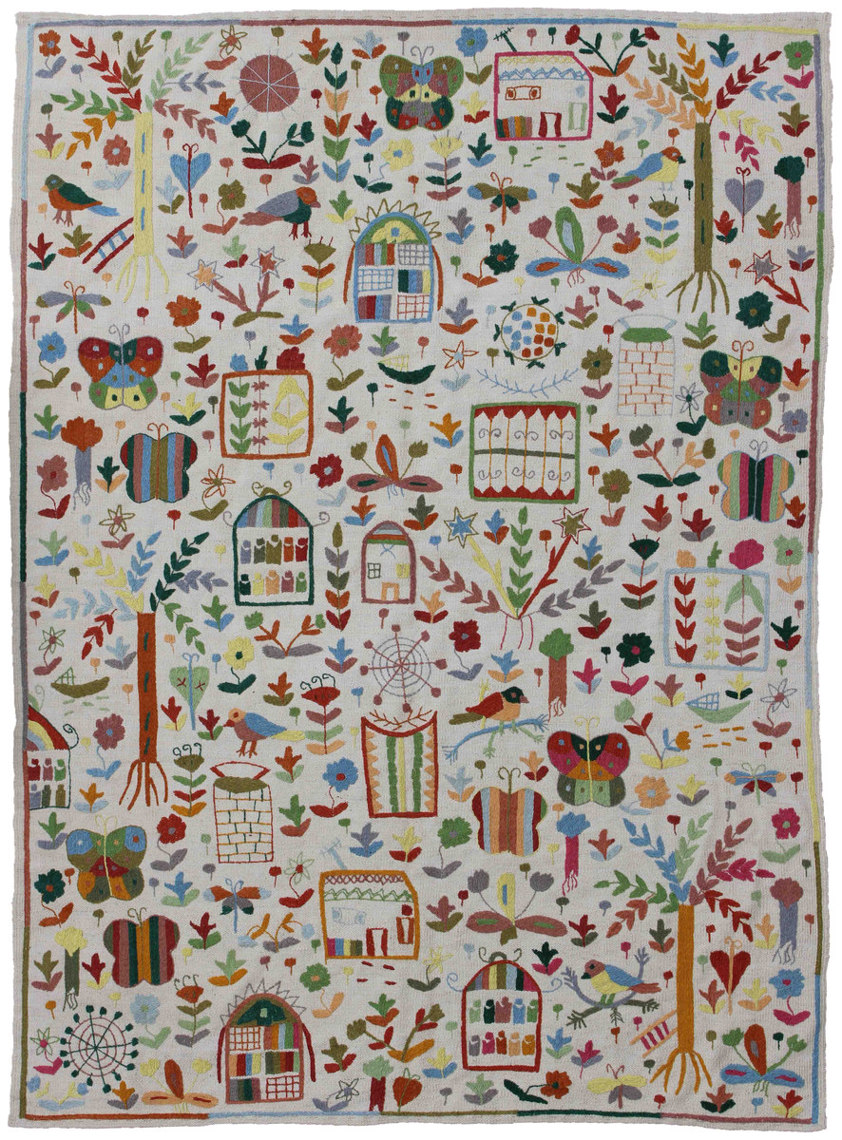
Little garden panels punctuate the densely occupied field of this rug. Some have rounded roofs and divided interiors, while others enclose upright plants or a close grid. Butterflies introduce broader paired wings among the rooted trees, birds and flowering stems. The palette ranges from red and yellow to green, turquoise and pink, with pale ground visible around the smallest marks as well as through many of the panel interiors.
The drawing rewards a closer look. Wheels, tiny rosettes and individual leaves create a secondary rhythm between the more readily recognised subjects. Taller trees give the composition occasional vertical accents, but there is no single dominant centre. A fine coloured edge allows the pictorial field to extend almost to the perimeter. Historical Suzani furnishings were associated with Central Asian embroidery, especially in Uzbek communities. Their ornamental richness often came from the interplay of prominent motifs and much finer subsidiary detail. Covers and hangings helped decorate household interiors.
This Afghan kilim gives that decorative background a miniature garden character, allowing many separate incidents to share a common light setting. At 223 × 163 cm, this rug could sit beside a modest sofa or in an open bedroom area. Simply shaped furniture would leave the panels and butterfly wings legible. Its red and green notes provide stronger accents, while the finer flowers offer smaller discoveries around the exposed edges.