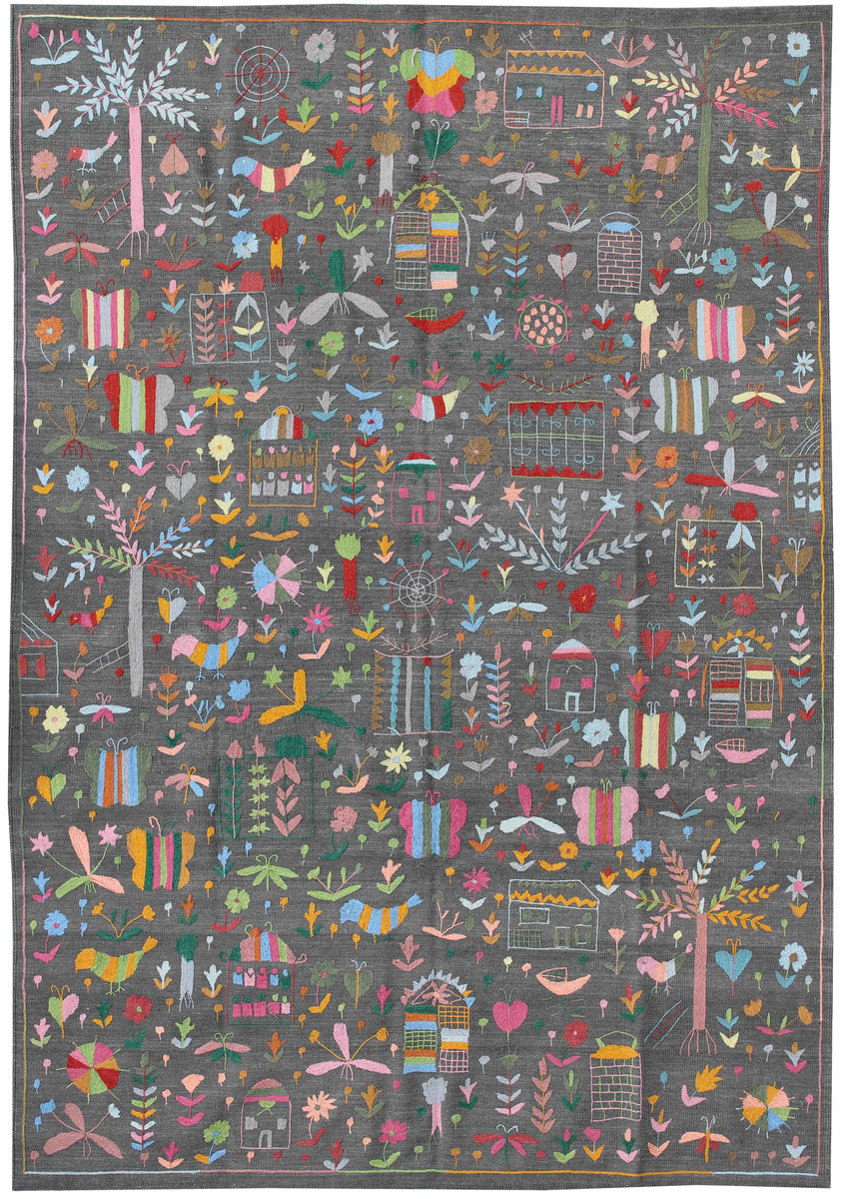
Tiny coloured forms enliven the charcoal-grey field of this rug. Rooted trees, birds, striped butterfly figures and roofed garden panels appear among fine flowers and leafy stems. Pink, yellow, blue, green and cream stand out in short, separate passages. Small wheels and framed plant compartments introduce further shapes, while a slender coloured line follows the perimeter.
The larger subjects remain distinct despite the density of the surrounding marks. Some panels contain a close grid; others rely on a few bold stripes or little coloured blocks. The plants are more fluid, with leaves changing direction around their stems. Suzani is historically associated with Central Asian embroidered covers and hangings, especially within Uzbek communities. The word itself refers to a needle, a reminder of that textile background rather than a specification for every rug bearing the name. This Afghan kilim gives its little scenes a dark setting, making fine coloured stems as noticeable as some of the broader figures.
At 294 × 204 cm, this rug could provide a detailed patterned base in a study or living room. Plain pale upholstery would contrast with the ground, leaving the little subjects clearly apparent around the furniture. One bright object elsewhere could pick up a selected accent rather than the entire palette. The larger trees and striped figures would register across the room. Along a visible edge near a chair, the delicate flower heads and tiny panel divisions would offer a different level of interest.