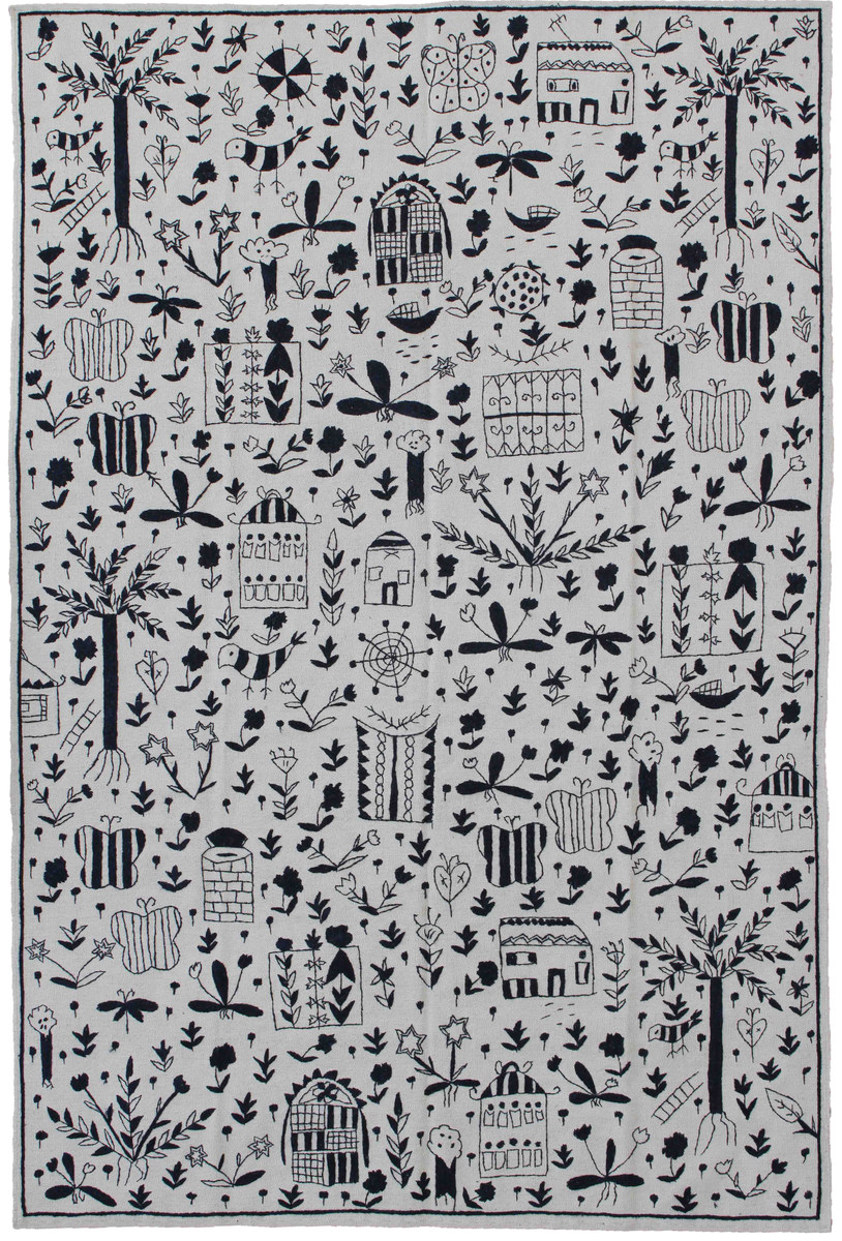
Fine black stems connect little leaves and flowers across the ivory field of this rug. Larger trees, small panels, birds and striped butterfly-like forms provide stronger points of emphasis. Some figures are nearly solid, while others contain fine grids or open internal lines. Circles and star-like ornaments introduce additional shapes between the plants, and a narrow dark line gives the rectangle a simple boundary.
The change from delicate line to fuller silhouette is especially important. A little flower can remain airy beside a much darker striped shape, while the open ground shows through the interior of a panel. Central Asian households used embroidered Suzani furnishings to introduce elaborate ornament into their interiors. Uzbek communities developed especially rich traditions of main motifs and supplementary detail.
This Afghan kilim uses that relationship in a monochrome pictorial direction, letting changes of scale and line weight take the role of multiple colours. Measuring 291 × 197 cm, this rug could bring intricate pattern to a study or sitting room with simply shaped furniture. Coloured artwork or a bright chair would sit comfortably above its restricted palette. A plain table would leave the surrounding miniatures distinct. The trees and broader figures would be legible from across the room, while the tiny leaves and panel divisions would reward a closer position. Its detailed field continues throughout, giving different exposed areas their own little incidents.