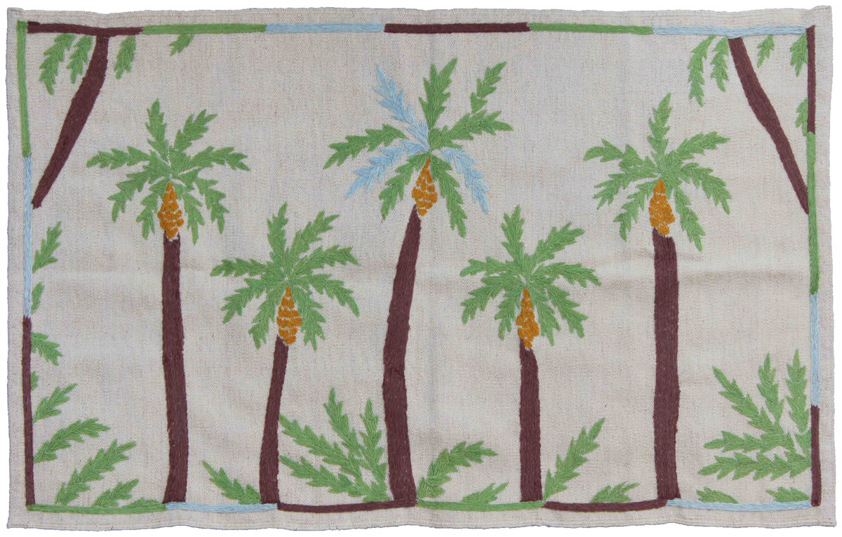
Slender brown palm trunks rise from the pale ground of this small rug. Their green crowns spread at different heights, with little yellow fruit-like details gathered beneath some of the leaves. Additional foliage enters from the edges, making the trees feel part of a wider scene. A fine changing-colour line gives the rectangle a simple boundary without enclosing it in a separate floral border.
The arrangement is open and horizontal in character. Broad pale intervals separate the trunks, allowing their slight curves and different heights to remain apparent. Green foliage appears near the lower edge as well as in the crowns. Plants occupy an important place in the decorative language of historical Central Asian Suzani embroidery. These textiles furnished domestic rooms, with Uzbek centres developing recognisable regional traditions of floral and foliate ornament.
This Afghan kilim’s palm scene gives the botanical subject an immediately pictorial form: the pale intervals between trunks matter as much as the spreading crowns. At 145 × 92 cm, this rug could provide a compact accent in front of a low cabinet or beside a chair. Light wood would relate to the pale ground, while green-painted furniture could answer the crowns. Its limited palette would leave room for other colours among nearby objects. The scene is worth keeping mostly exposed, since the alternating trees and open intervals form the principal composition. Nearby, the smaller leaf divisions and warm details beneath the crowns would add a finer scale of interest.