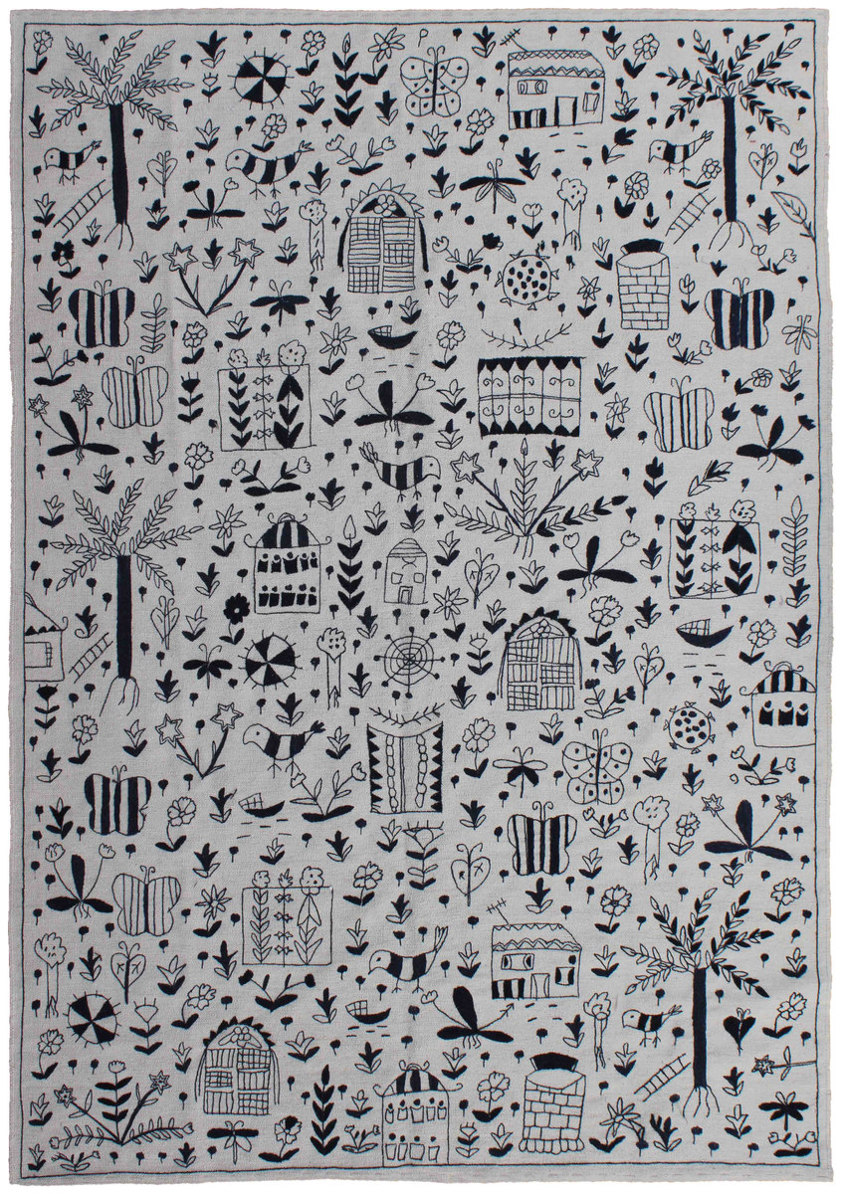
Small buildings and finely patterned panels sit among the black plant sprigs on this rug. Animal figures, wheel-like circles and striped shapes introduce additional subjects, each separately placed against ivory. Some motifs are rounded, others angular or tall, so the eye moves through a changing assortment of outlines. Fine lines at the edge provide a simple boundary. The monochrome drawing gives the field a particular clarity. Dark filled forms establish stronger accents, while open panels allow ivory to remain visible within their outlines.
Little flowers and leaves connect selected gaps without forming one continuous vine. The effect is closer to an accumulation of individual sketches than a regular all-over floral repeat. Historically, Suzani textiles were closely involved with domestic decoration in Central Asia, particularly within Uzbek and neighbouring communities. Their large motifs and supplementary small details enlivened covers, hangings and other household furnishings.
This Afghan kilim develops that decorative background into a graphic field, with the contrast between outline and silhouette supplying its principal variation. Measuring 286 × 200 cm, this rug would work well with simply shaped furniture in a study or an informal living room. It could provide a measured base beneath brightly coloured objects, since its own colours stay restrained. A clear area near a chair would make the smaller internal drawings easier to appreciate. The little structures and plants remain varied throughout the rectangle, giving different exposed sections their own points of interest.