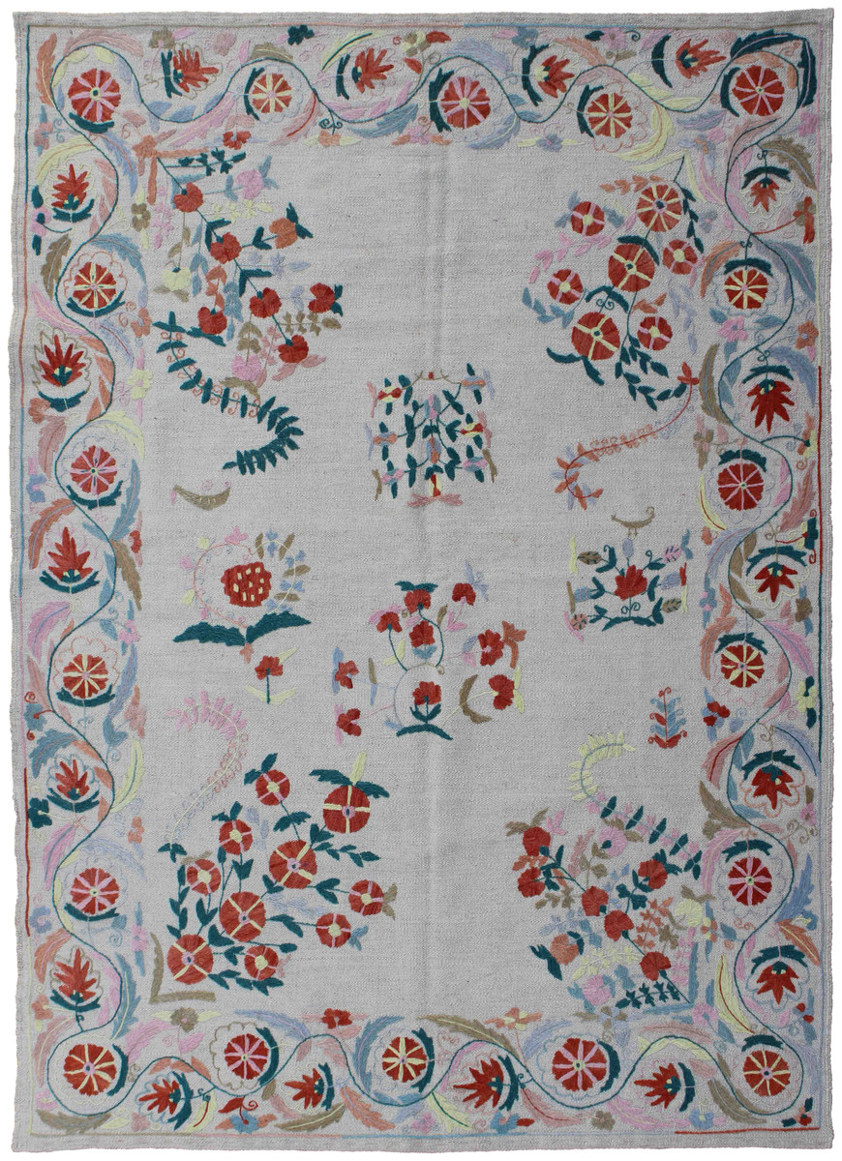
Red blossoms and blue-green leaves gather into separate little groups on the ivory field of this rug. Some stems bend outward from a compact flower head, while others trail into the open ground. The border repeats red circular forms, linked by broad curling vines in pink, blue and pale green. Its fuller drawing gives the spacious centre a definite botanical frame. The arrangement is light rather than symmetrical in every detail. One bouquet may be larger than its neighbour, and isolated leaves or curved marks occupy selected gaps.
That variation gives the field a relaxed character. Around the edge, the roundels provide a steadier rhythm, with small leaf forms changing direction between them. Bold blossoms and scrolling foliage are central elements in the Suzani embroidery traditions of Central Asia. Historical household pieces from Uzbekistan and nearby communities often used a contrast between larger border ornaments and more finely drawn inner subjects.
This Afghan kilim interprets those decorative relationships through an open ivory surface and a softly coloured surrounding vine. At 235 × 169 cm, this rug could lighten a bedroom or provide a gentle pattern beneath a small sitting group. Plain ivory fabrics would continue the ground, while a green or blue object would answer the leaves. Its border is worth keeping visible beside the furniture, where the rounded flowers supply stronger accents than the scattered field sprigs. The interior can remain partly occupied without losing that changing outer movement.