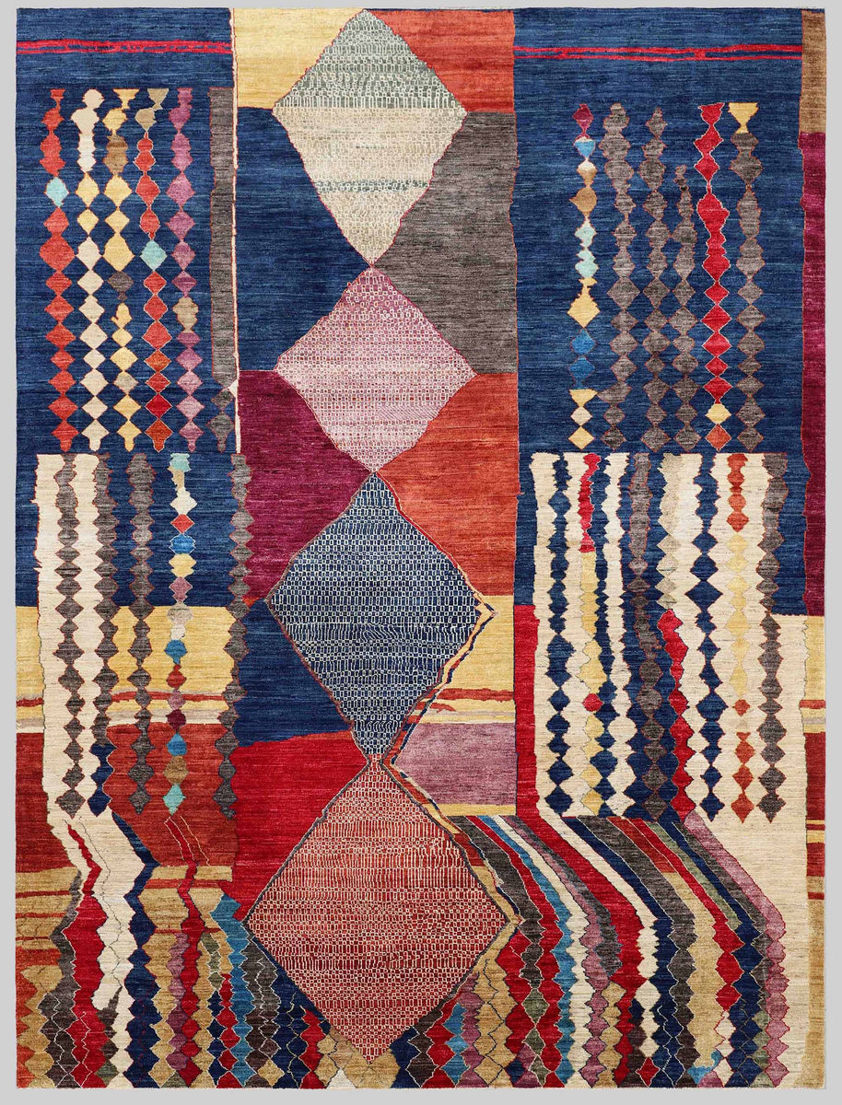
Broad diamonds form a central chain on this rug, their interiors filled with fine, closely spaced marks. On either side, columns of smaller lozenges sit within changing bands of blue, red, ochre, cream and brown. The lower section shifts again into angled stripes, giving the composition a more fluid ending.
Narrow lines separate some of the larger colour areas without creating one enclosing ornamental border. The changing scale is particularly distinctive. The central diamonds are large and expansive, while the little repeated lozenges establish a much finer rhythm. Some side passages are pale, others deep blue or red, so the same small shapes acquire a different emphasis as the ground changes. The fine marks inside the larger devices add another level of texture. Suzani belongs to the history of Central Asian decorated household textiles, especially the expressive furnishings associated with Uzbek communities.
This Afghan kilim takes that decorative reference into a contemporary geometric composition, using bold colour divisions and individually patterned forms. Its 360 × 264 cm dimensions give the contrasting sections enough space to develop across a substantial floor area. A room with relatively plain furniture would show the differences between those sections most clearly. The large central chain could remain partly visible beside a low table, while the smaller lozenge columns would continue to provide detail around the seating. The angled lower stripes offer a useful point of emphasis where the rug meets an open stretch of floor.