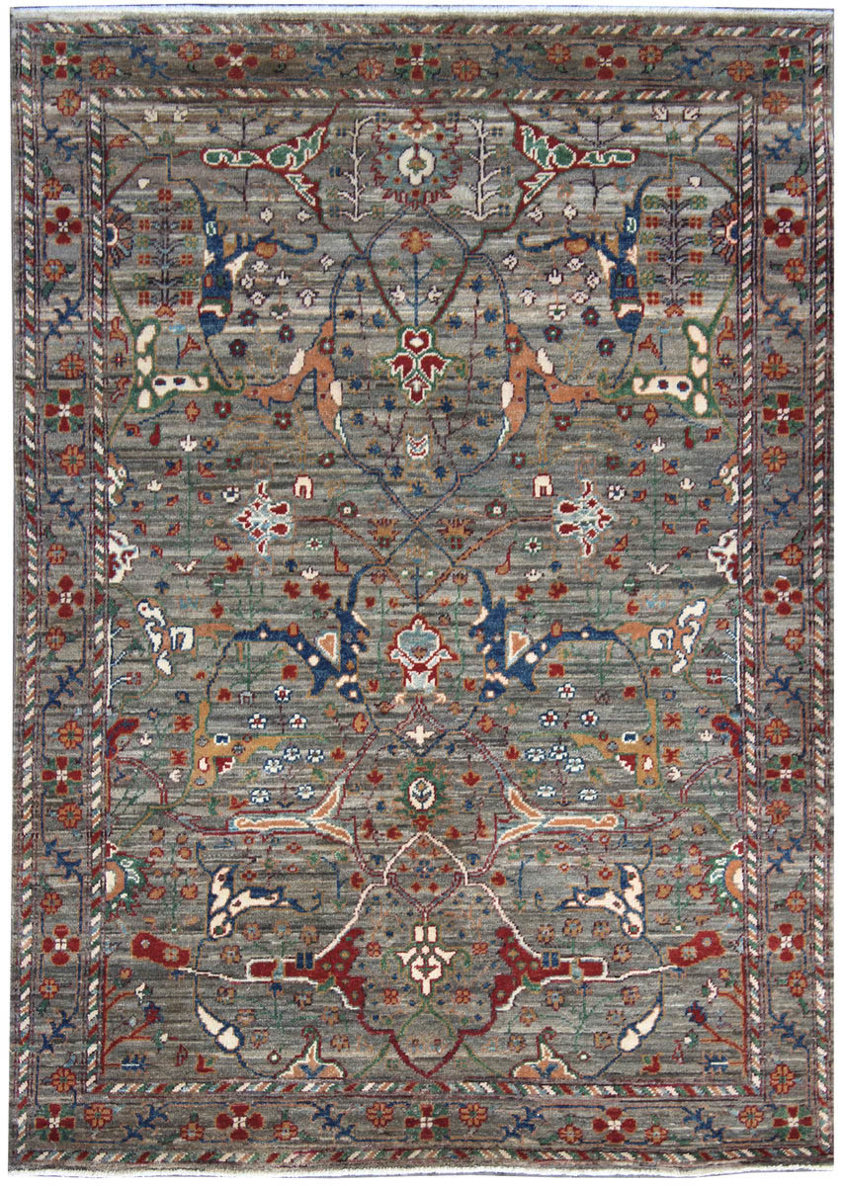
Angular branches and small flowers spread evenly across the muted grey centre of this Afghan Feraghan rug. Pale curved leaves are picked out against darker outlines, with red, blue and ochre accents appearing at intervals. The pattern is held within a sequence of narrow borders, which repeat the principal colours in a more compact decorative register. There is a measured balance between repetition and variation.
Larger paired forms provide structure, while tiny blossoms and connecting stems occupy the spaces between them. Horizontal changes in the grey background soften the drawing and give the surface a layered appearance. The result is detailed without depending on a bright ground colour, making the smaller accents particularly noticeable as the light and viewing distance change. The Feraghan name connects the design with Persian floral traditions associated with Farahan. Repeated botanical arrangements and framed fields are part of that historical vocabulary, which has been adapted across different rug-making centres.
This example remains identified as Afghan; the regional style reference should be understood as a design connection rather than a claim of Iranian manufacture. At 177 by 125 cm, this rug could add a concentrated area of pattern beside an armchair or at the foot of a bed. Its restrained ground would relate easily to stone, natural timber and soft neutral fabrics. A red ceramic or blue textile elsewhere could pick up a minor colour from the field, giving the surrounding scheme a subtle sense of continuity.