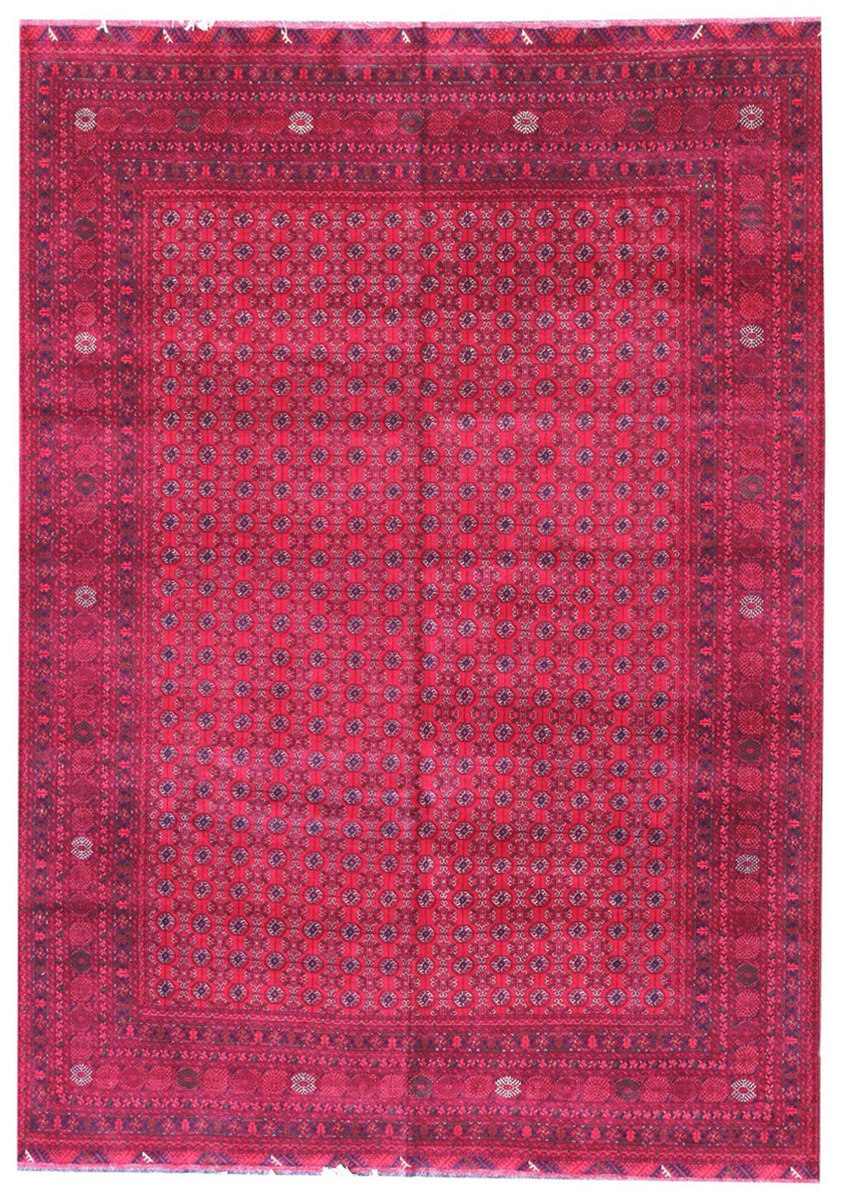
A multitude of small medallions gives this rug its remarkably even pattern. Set in close rows over a strong red field, their darker outlines create a fine, regular rhythm rather than a single dominant focal point. Several surrounding borders vary the scale of the drawing, with larger pale details punctuating the outer areas. This rug would lend itself to a room where furniture needs to sit comfortably across the centre. The repeated field remains legible in the exposed areas around a table or sofa, and the borders preserve a clear outline.
At 246 by 300 centimetres, its broad format could accommodate a generous seating arrangement. Dark wood would relate to the deeper lines within the medallions, while pale upholstery would pick up the smaller light accents. Bokhara is a trade name closely associated with carpets drawing on Turkmen design traditions. Historically, repeated gul medallions were an important feature of Turkmen main carpets, with forms and arrangements varying between groups.
This Afghan Bokhara rug belongs to that wider decorative vocabulary through its ordered medallion field and layered borders. The name provides a stylistic context alongside its stated Afghan origin. What distinguishes this example is the small scale of its central repeat. From a distance, the red becomes the main impression; closer by, the many individual motifs resolve into an intricate surface. The pale border details offer a change of pace around that dense, carefully organised centre.