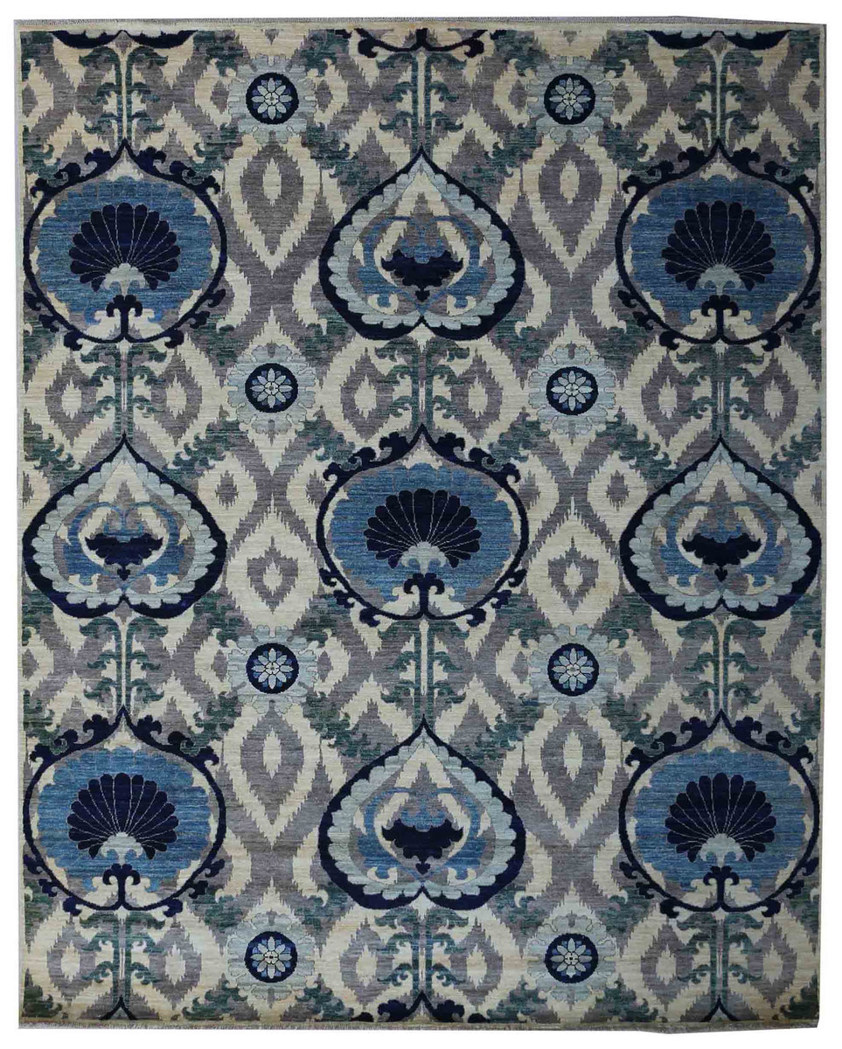
Blue flower heads alternate with pointed palmettes across this rug, their large outlines set against a pale grey and cream ground. Fine stems connect the forms vertically, while small roundels punctuate the spaces between them. A looser grey geometric pattern sits behind the main drawing, giving the field more than one scale of ornament.
The Arts and Crafts tradition brought stylised plants into carefully organised domestic patterns. William Morris studied Persian carpets when developing his own carpet designs, drawing on their relationship between repeat and botanical detail. This Afghan rug interprets that broader decorative heritage through enlarged flowers, slender stems and a restrained blue palette.
The generous 244 by 296 centimetre format could anchor a substantial seating group. Plain upholstery would allow the palmettes to remain clear, and warm timber could soften the cool grey background. A blue chair would connect with the darker petals, while cream curtains would pick up the lighter internal drawing. The repeated field stays recognisable around furniture without requiring a single central motif to remain exposed. This rug is particularly appealing where the broad flower heads meet the finer stems. The different sizes create a measured rhythm across the rectangle. From a distance the blue forms establish the pattern; nearer by, the grey background and small roundels become more apparent, providing detail within an arrangement whose first impression is spacious and clearly ordered.