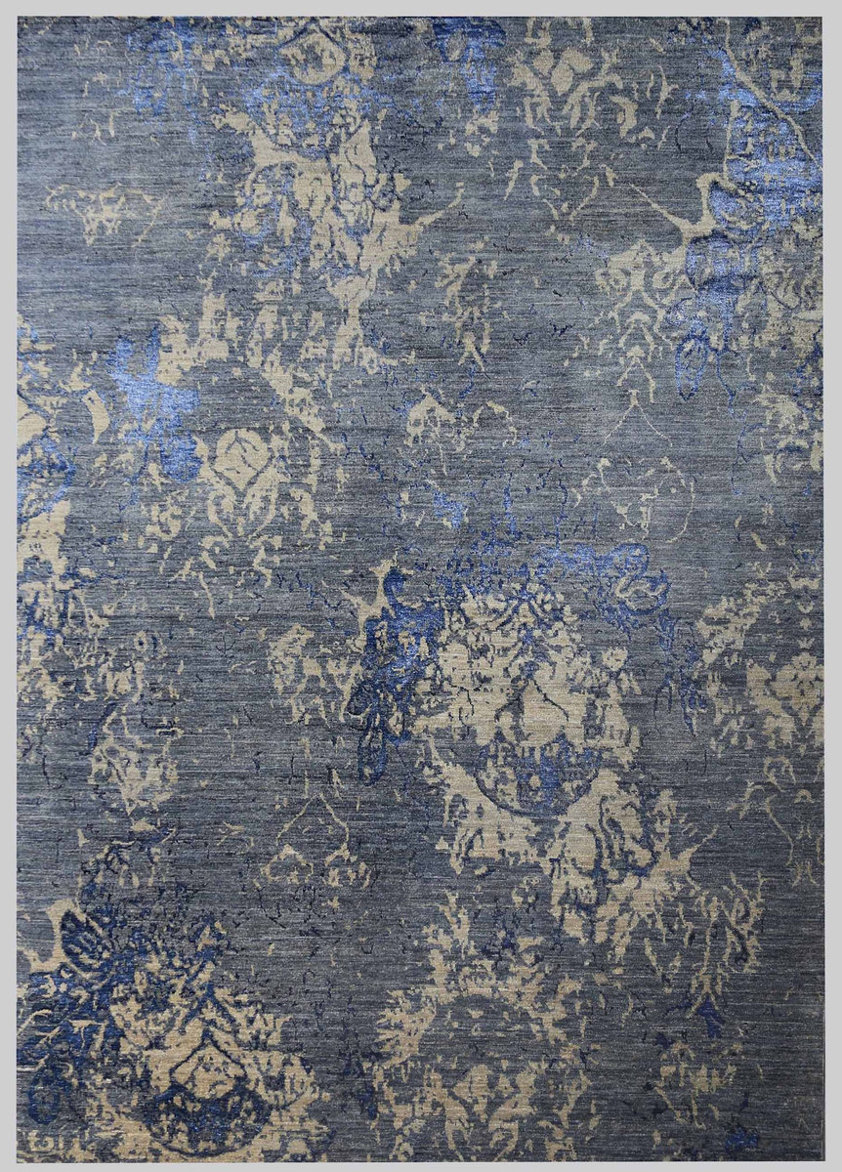
A large pale curled ornament occupies one side of this rug, its interior picked out in deeper blue. Related fragments appear towards the opposite upper edge, with fine vines and small leaf-like marks crossing the intervening blue-grey. Some areas are closely drawn, others almost open. The perimeter continues the changing pattern without a separate emphatic border. The larger ornament is especially attractive where its cream outline meets the slate-coloured ground. Rounded edges remain recognisable despite the breaks in the drawing, while smaller detached curls carry the pattern beyond its main shape.
Blue varies subtly across the surface, giving the quieter areas more depth than a single flat colour would provide. The carpet traditions of Afghanistan share an extensive decorative landscape with neighbouring Persian and Central Asian cultures. Contemporary transitional designs often reconsider botanical forms from that wider repertoire, changing their scale or leaving parts deliberately incomplete. This Afghan part silk rug concentrates on the balance between one substantial pale motif and more scattered traces of related ornament.
At 294 × 199 cm, this rug would suit a sofa group arranged slightly away from the exact centre. That would leave the larger side ornament more fully visible. Plain blue upholstery could connect with its deeper details, and cream fabrics would echo the outer curls. A relatively simple surrounding floor would also allow the smaller detached lines to remain apparent at the edges of the furniture.