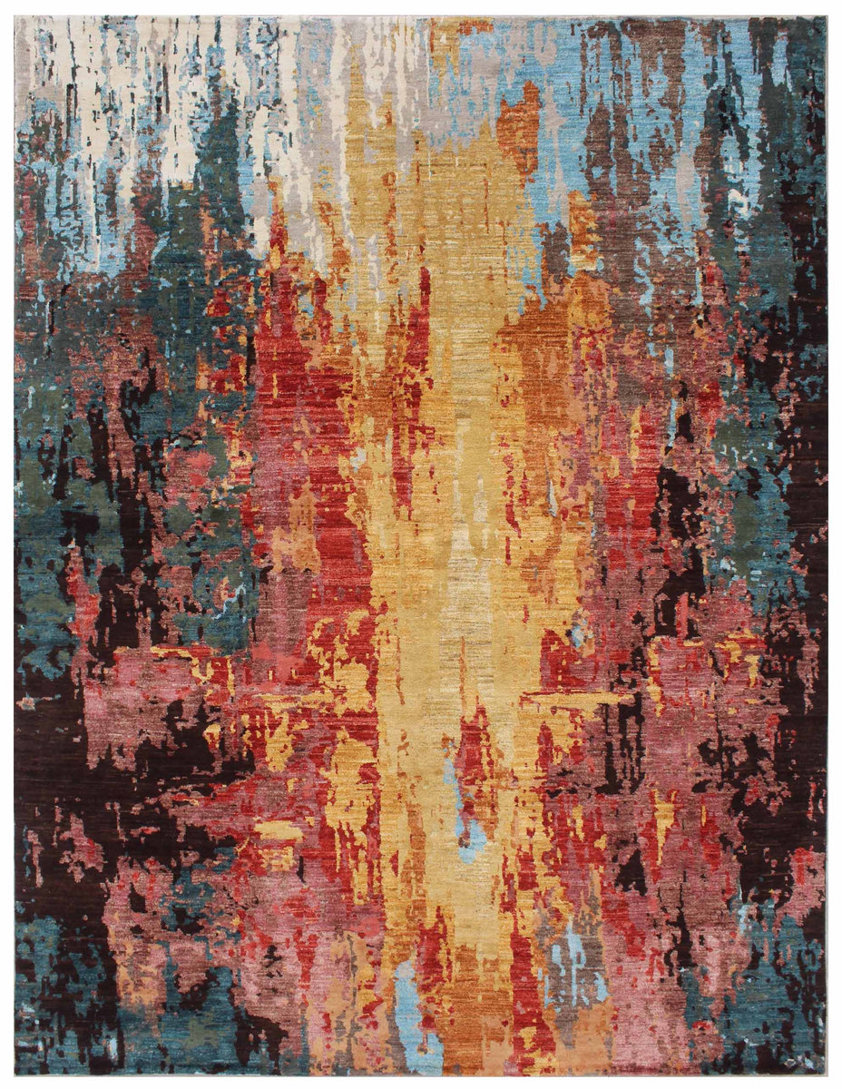
A broad gold passage runs through the centre of this rug, surrounded by broken areas of blue, rose, red and charcoal. The marks are mainly vertical, though their edges fragment into smaller horizontal flecks. Pale blue is strongest towards the upper end, while darker passages gather at the sides and lower corners. There is no separate border to interrupt the changing colour. The design has depth because no large area is entirely uniform. Warm orange and red emerge within the gold, pink crosses darker sections, and small pale marks appear among the blue.
The movement is expansive, with the lighter central area giving the eye somewhere to settle between the more closely worked passages. Afghanistan's carpet culture has historically interacted with neighbouring Central Asian and Persian traditions. Contemporary production accommodates a broad range of decorative approaches alongside established regional patterns. This Afghan part silk rug takes an abstract direction, allowing fields of colour and fragmented marks to perform the organising role that a medallion or repeated ornament might otherwise provide.
At 300 × 202 cm, this rug could form the principal colour feature in a sitting area or study. A plain sofa would give the shifting marks a clear setting, and a dark table could relate to the charcoal at the edges. Pale blue walls or a small gold-toned object could bring forward one aspect of the palette. The uninterrupted central passage is particularly worth considering when arranging furniture, as it gives the composition its sense of openness.