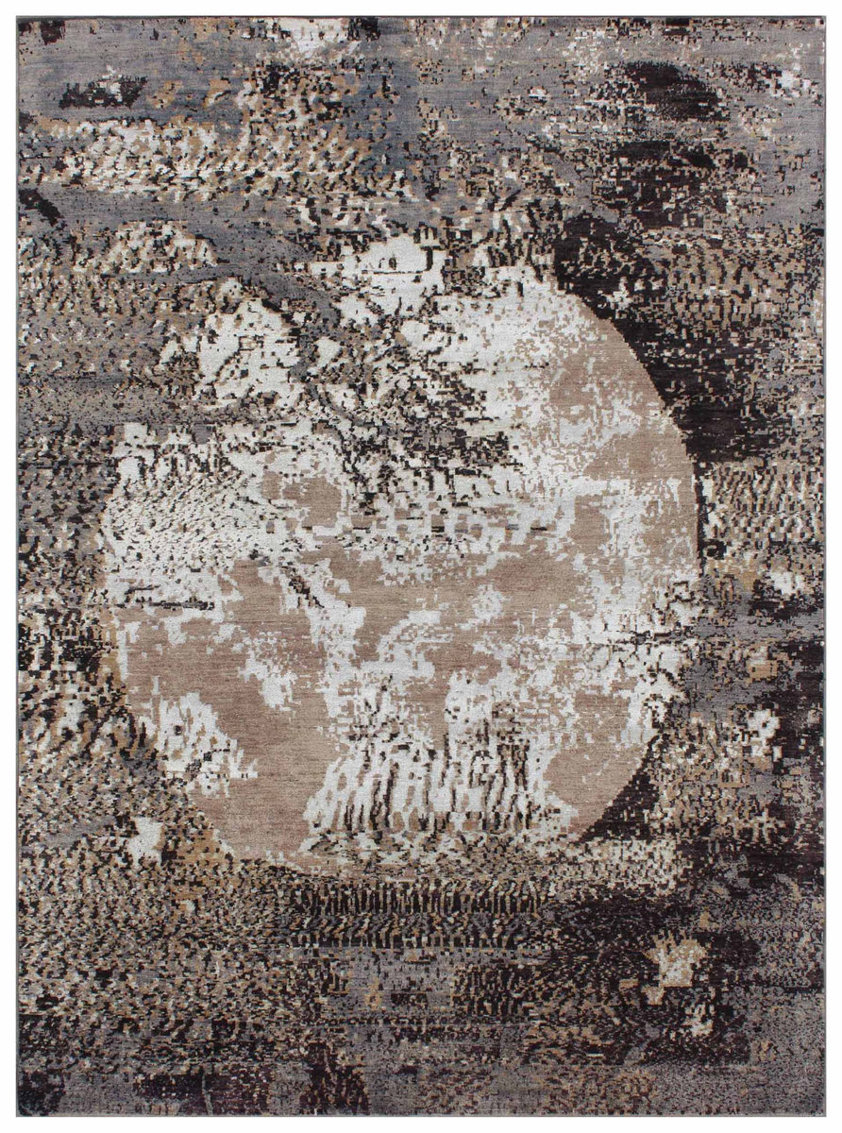
A pale circular form emerges through the broken grey and charcoal markings of this rug. Its edges are interrupted rather than cleanly outlined, with taupe and ivory passages passing into darker areas around it. Across the rest of the field, small repeated marks and larger irregular patches create a layered, almost printed-looking effect. There is no separate ornamental border to interrupt the composition. This part silk Afghan rug takes a contemporary approach to surface and pattern.
The large curved form provides a loose focus, but the eye is also drawn to the smaller interruptions around its edge. Warm taupe softens the charcoal and grey, giving the palette enough variation to work with both pale furnishings and darker architectural details. Afghanistan has a long textile history shaped by connections with Central Asia, Iran and the Indian subcontinent. Its carpet repertoire has continually accommodated different sources of ornament.
This rug belongs to a contemporary abstract direction within that broader tradition, using tonal fragmentation and an incomplete circular shape in place of a conventional floral medallion. At 287 × 196 cm, this rug would suit a seating area with simple furniture profiles. A pale sofa would relate to the central disc, while black metal or dark timber could echo the surrounding marks. It would also provide an effective base for a restrained room with strongly textured fabrics, where the pattern could contribute movement without introducing several bright colours.