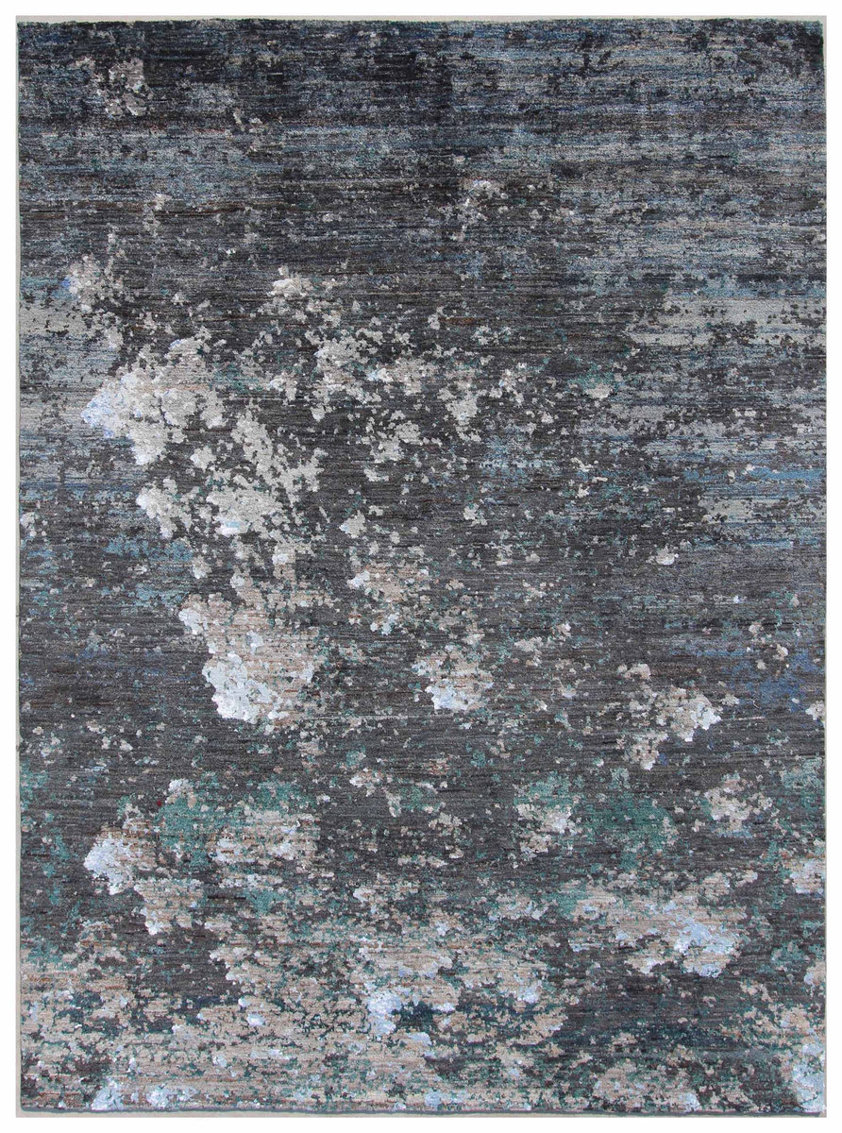
Pale grey ornamental fragments gather over charcoal in this rug, suggesting a broad medallion within the darker field. Blue-green details soften several passages, while fine horizontal marks interrupt the outlines. Parts of an enclosing framework remain visible near the edges, although the drawing changes in clarity across the surface. This part silk Afghan transitional rug retains a connection with traditional medallion organisation while presenting it through fragmentation. The larger forms provide a point of reference, but their boundaries disperse into smaller marks.
Some areas are closely patterned; others allow the dark ground to become more prominent, creating an uneven but coherent tonal balance. At 239 by 298 centimetres, this rug could anchor a substantial seating group. Pale upholstery would relate to the grey ornament, and dark wood would connect with the deeper field. A little muted blue or green elsewhere could acknowledge the finer details without introducing another strong pattern. Keeping part of the middle visible would preserve the suggestion of the medallion.
The lighter areas are particularly effective where they meet open charcoal, giving the broken shapes a sense of depth. From a doorway, this rug offers a clearly contrasting light-and-dark arrangement. Closer by, small lines and scattered ornamental traces become easier to follow. That shift in scale gives a relatively restrained palette considerable interest, with the fragmented field allowing different passages to emerge around the furniture.