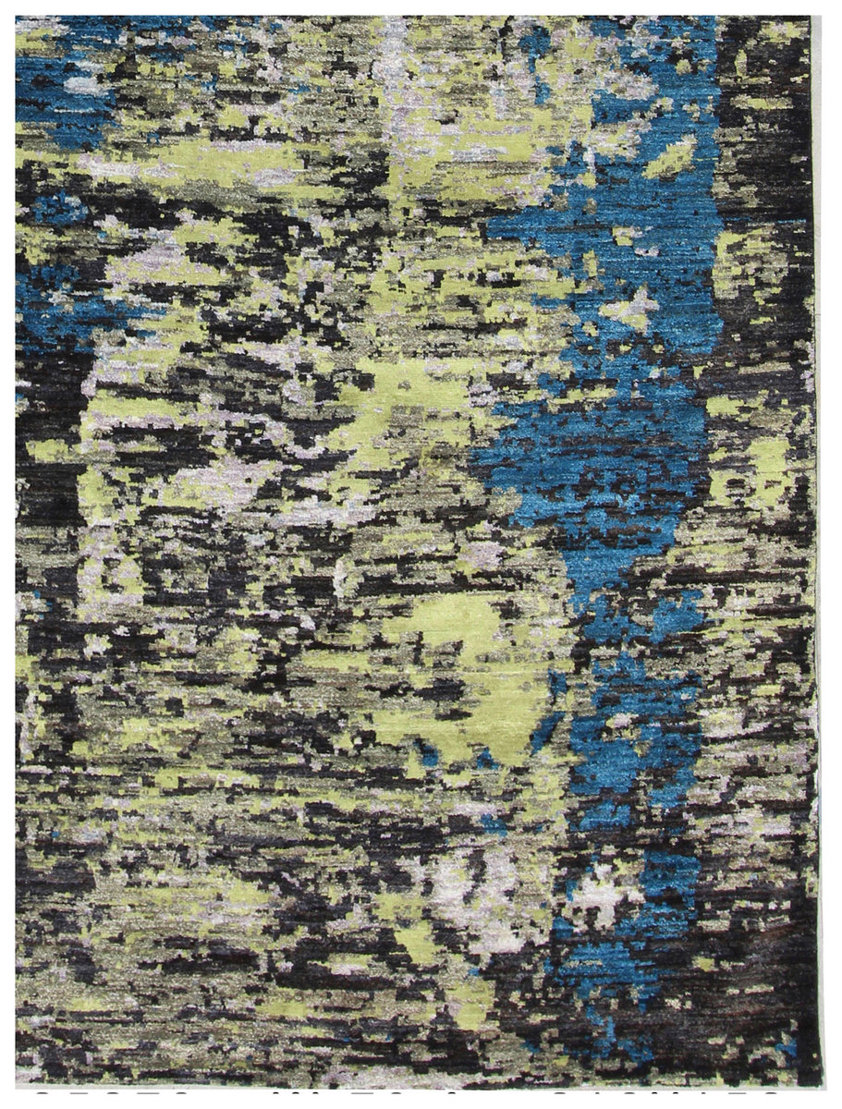
Blue and pale lime create a lively contrast with the charcoal ground of this rug. Some areas contain closely packed light marks; others open into broader passages of blue. Fine horizontal interruptions run through both, giving the surface a consistent direction despite the irregular arrangement of colour. The pale lime is particularly noticeable against the darkest sections. It introduces warmth without changing the essentially cool character of the blue. This rug has no central medallion or strong outer frame. Instead, the changing density of the lighter drawing supplies points of emphasis across the whole rectangle.
At 150 by 207 centimetres, this rug could bring a defined area of abstract pattern to a small sitting room or study. A dark desk or table would relate to the ground, while pale upholstery could connect with the lighter marks. A little green elsewhere would be enough to acknowledge the lime without making it a dominant room colour. This part silk Afghan transitional rug belongs to a contemporary approach in which colour fragments take the place of a continuous ornamental field.
The design remains readable at different distances: broad blue and pale green passages emerge first, then smaller broken lines become apparent nearby. Its appeal rests on that changing scale, with the dark ground giving the finely scattered details enough contrast to remain distinct. Leaving some of the middle uncovered would reveal the interaction between the larger blue areas and the closely marked lime passages.