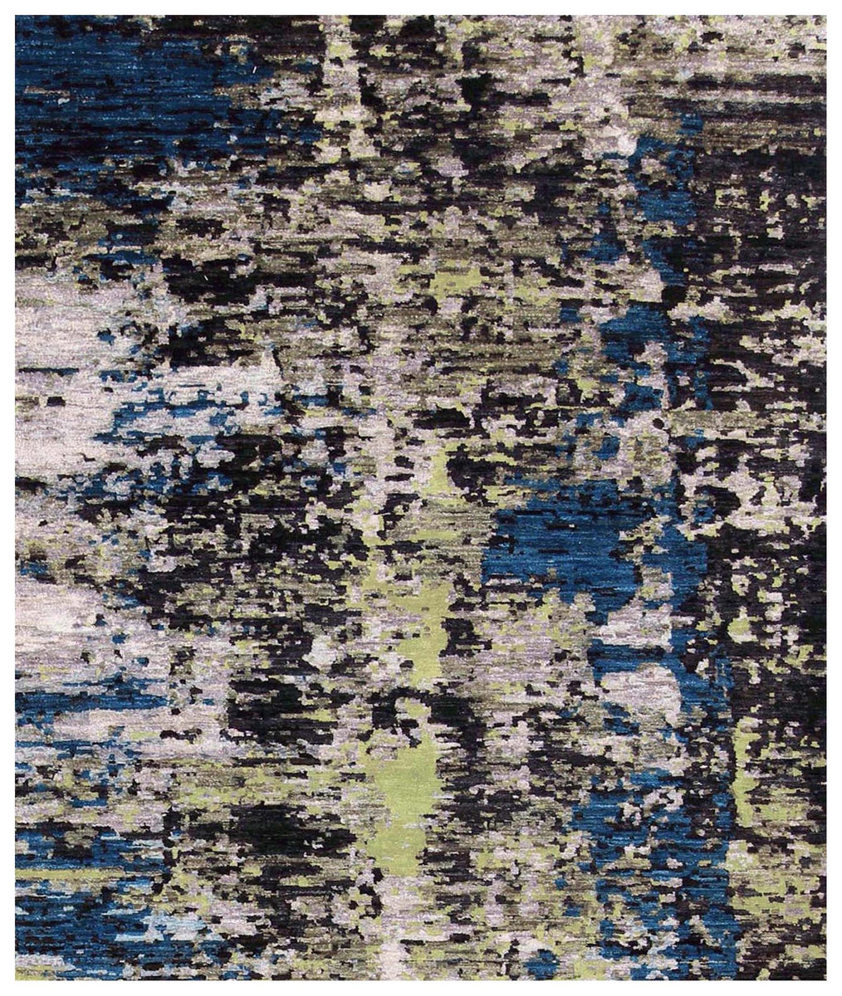
Blue and pale green fragments meet cream and charcoal across this rug. Several light passages open through the darker drawing, while stronger blue areas give the composition a cooler emphasis. Fine horizontal marks interrupt the larger forms, so their boundaries remain broken rather than sharply divided. This rug has relatively broad 184 by 219 centimetre proportions. It could define a compact seating group or provide an area of pattern beside furniture in a study. A cream chair would relate to the lightest passages, while darker wood would connect with the charcoal.
Pale green accessories could draw out a quieter colour within the field. The design of this part silk Afghan rug is built from the relationship between broad abstract areas and smaller scattered marks. The rectangle retains an overall coherence through its limited colour family, but the internal drawing does not settle into one continuous ornamental repeat. This freer arrangement is part of the contemporary Afghan repertoire alongside more formal geometric and floral designs.
The contrasts become especially interesting where cream meets blue near the sides. Some details remain clear as short lines; others merge into a broader tonal passage. This rug offers a strong light-and-dark composition across the room, then reveals much finer interruptions nearby. Its balance does not depend on keeping a central medallion visible, allowing furniture to occupy part of the field while the surrounding fragments continue to carry the design.