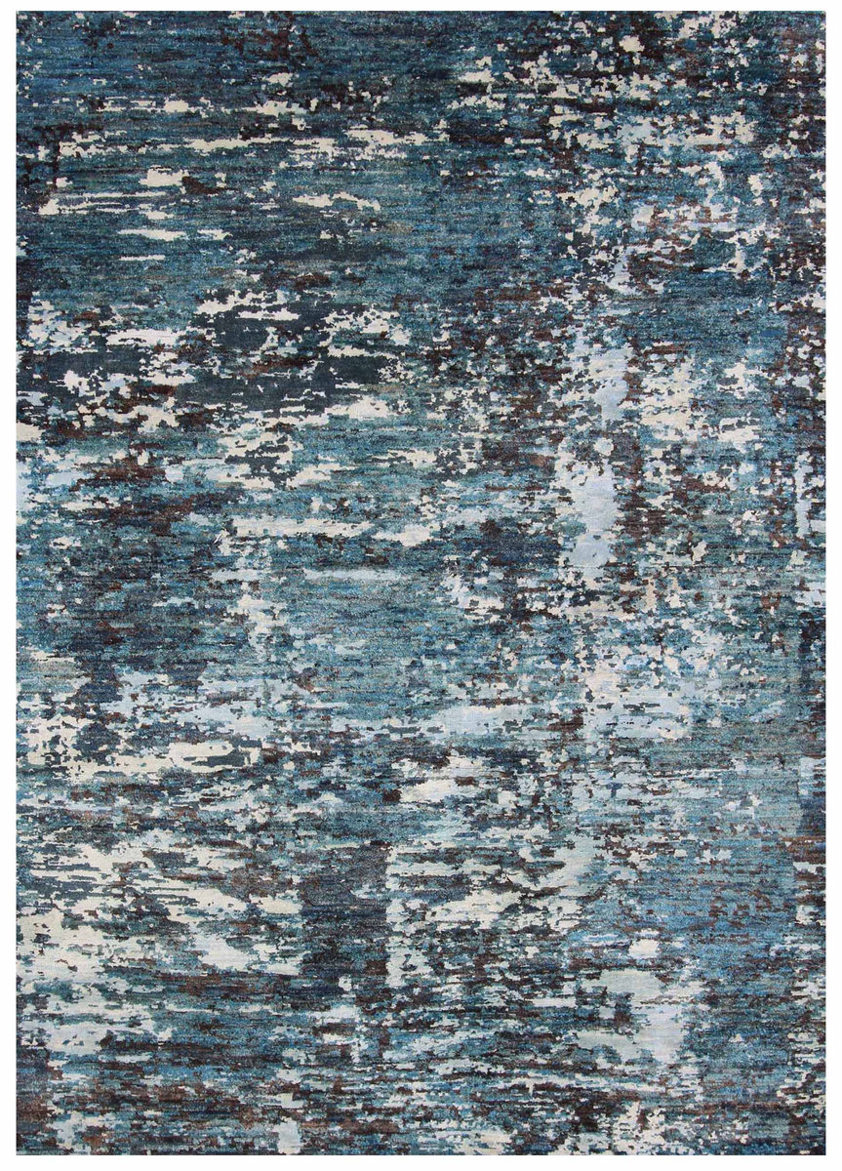
Deep blue and charcoal give this rug a rich, closely coloured field. Pale broken marks spread unevenly across it, sometimes gathering into broad patches and elsewhere thinning into short horizontal lines. The lighter interruptions are distributed throughout, so no single motif becomes the centre of the composition. This rug could provide a firm area of colour in a room with pale upholstery or warm timber. Its 169 by 239 centimetre proportions would suit a compact seating group, where the smaller marks could remain visible around a table.
Cream fabric would connect with the lightest details, while darker furniture would bring the blue-grey variations into sharper relief. This part silk Afghan transitional rug organises its pattern through changes of density rather than a conventional medallion and border. Abstract compositions of this kind allow colour to carry the larger structure, with small fragments providing detail at close range. Here the blue links the darker and lighter areas, keeping the whole rectangle coherent despite the irregular drawing.
The pale clusters are particularly effective beside the quieter blue passages, where their broken edges create a finely textured pattern. Seen from a distance, those details merge into a broader movement of light across dark. Nearby, individual marks become clear, revealing differences in length and spacing. This rug would be well placed where it can be viewed both across the room and at close quarters, allowing that change of scale to remain part of its appeal.