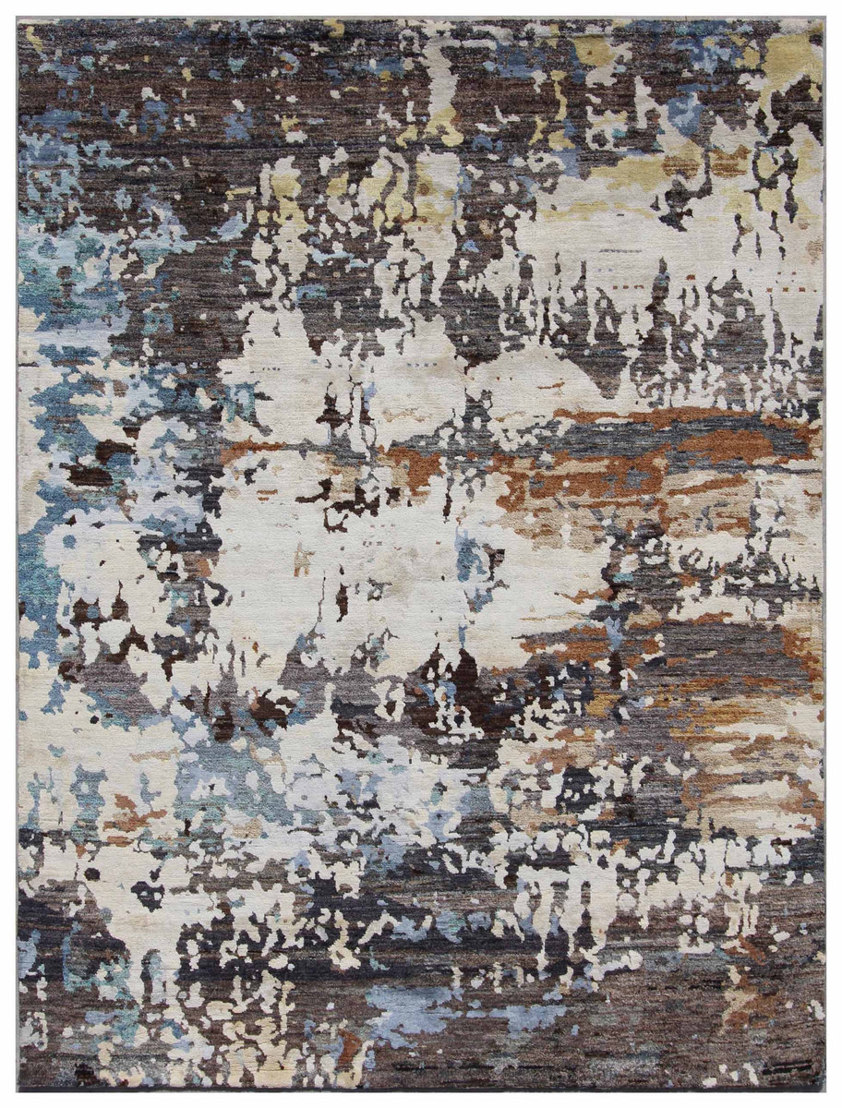
Ivory passages open through brown and blue in this rug, creating a strong contrast between broad light areas and smaller dark fragments. A rust-coloured horizontal accent gives one side additional warmth, while the upper field gathers into deeper brown. Fine blue-grey marks remain visible within the lighter sections, connecting them to the surrounding colour. This part silk Afghan transitional rug has an irregular composition that can be read from several directions. Some forms are broad enough to register across a room; others resolve into short lines and small interruptions nearby.
The distribution of light and dark provides the structure, allowing the surface to remain coherent without a central medallion or continuous floral border. Its 180 by 243 centimetre proportions would suit a modest living room or study. A cream sofa could relate to the largest pale passages, while dark wood would echo the deeper areas. A muted blue chair or fabric could connect with the cooler fragments, leaving the rust as a smaller accent within the room.
The most interesting boundaries are those where the ivory breaks into blue and charcoal. Their finely interrupted edges give the field a sense of depth, while the longer horizontal marks lead the eye across it. This rug would retain its character around a table because the detail is dispersed throughout the surface. Each exposed section contributes another part of the same layered arrangement of pale space and darker drawing.