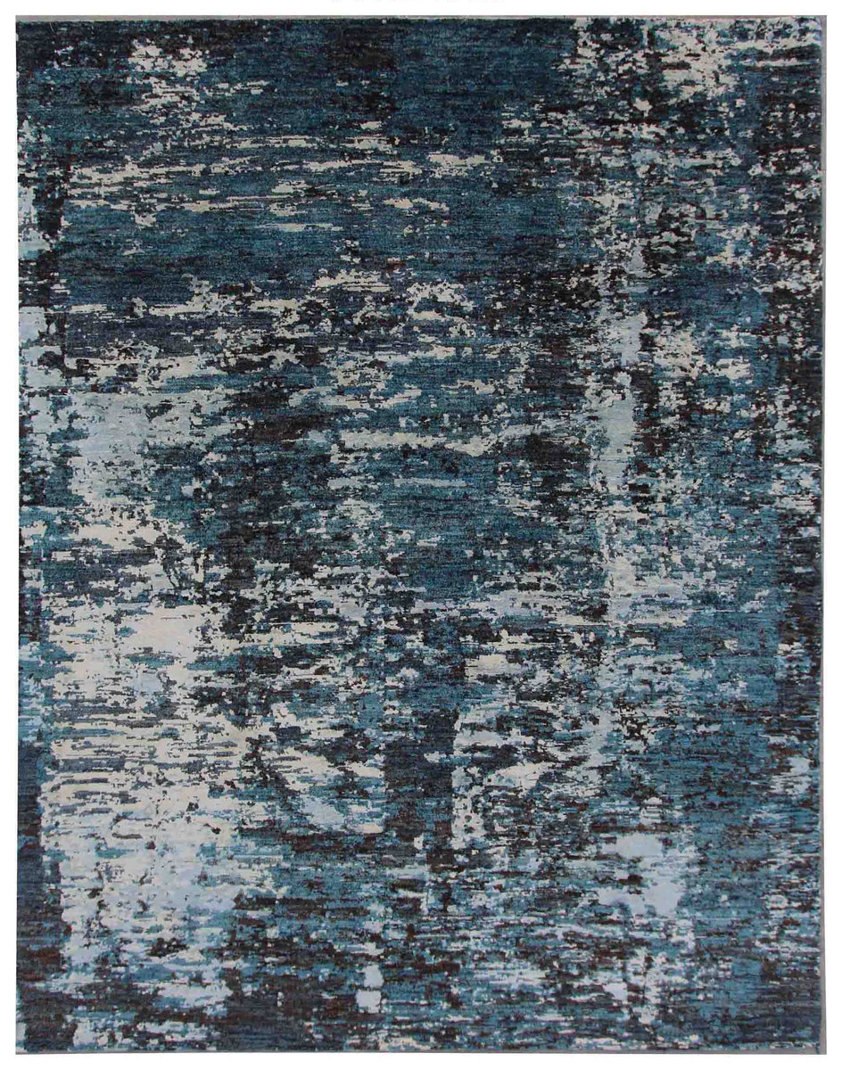
Pale fragments interrupt a deep blue field in this rug, with darker charcoal passages adding further changes of tone. Short horizontal marks appear in clusters, then give way to more open areas of blue. The drawing has no single centre, allowing the eye to move between different concentrations of light and dark across the rectangle. This part silk Afghan transitional rug gives the small mark a structural role. Rather than enclosing a complete floral field within borders, it distributes broken detail throughout the surface.
Broad tonal areas remain visible beneath the finer drawing, so the design can be read both as an overall blue composition and as a collection of smaller abstract passages. Its 243 by 305 centimetre proportions would suit a generous living room or a substantial dining setting. Cream upholstery could relate to the pale fragments, while a dark table would connect with the charcoal.
Warm timber would provide a useful companion to the cooler blue, keeping the room from becoming entirely grey-toned. The lighter clusters are particularly effective where they meet quieter sections of the field. Their uneven spacing prevents the horizontal movement from becoming a regular stripe. This rug remains visually consistent when furniture covers part of the centre, because its interest is distributed across the whole design. At close quarters, the many short lines reveal a finer rhythm, giving depth to a palette that appears comparatively simple from further away.