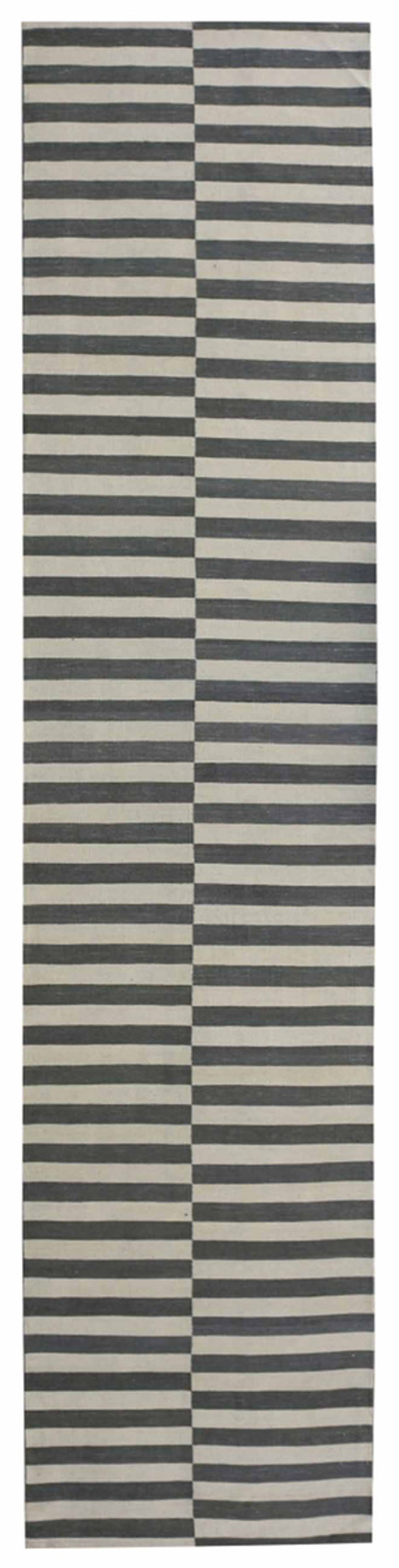
Black and cream stripes extend across this runner in two offset sequences. A division along the middle shifts the bands out of alignment, turning a simple repeat into a more considered geometric arrangement. Fine variations within the darker areas soften the contrast, while the cream remains clearly visible from one end to the other. The exceptional 482 centimetre length gives this runner a sustained rhythm across the floor. At 100 centimetres wide, it has enough breadth for the offset to remain apparent when viewed along a hallway.
A long landing or generous passage would allow the two sequences to unfold, with doors and furniture providing occasional changes of viewpoint rather than concealing the design altogether. Kilims form part of the longstanding flatweaving traditions of Afghanistan and neighbouring regions. Their designs often make effective use of clear colour divisions, from narrow stripes to more elaborate geometric fields.
This contemporary Afghan kilim runner reduces the vocabulary to parallel bands and a central shift, relying on proportion and spacing for its decorative effect. Against warm boards, the cream would provide light and the black would define the route through the space. The palette could also connect with painted joinery or dark picture frames without introducing another strong colour. This runner is most interesting at the centre line, where each stripe meets a different tone on the opposite side. That small displacement keeps the extended repeat from becoming predictable.