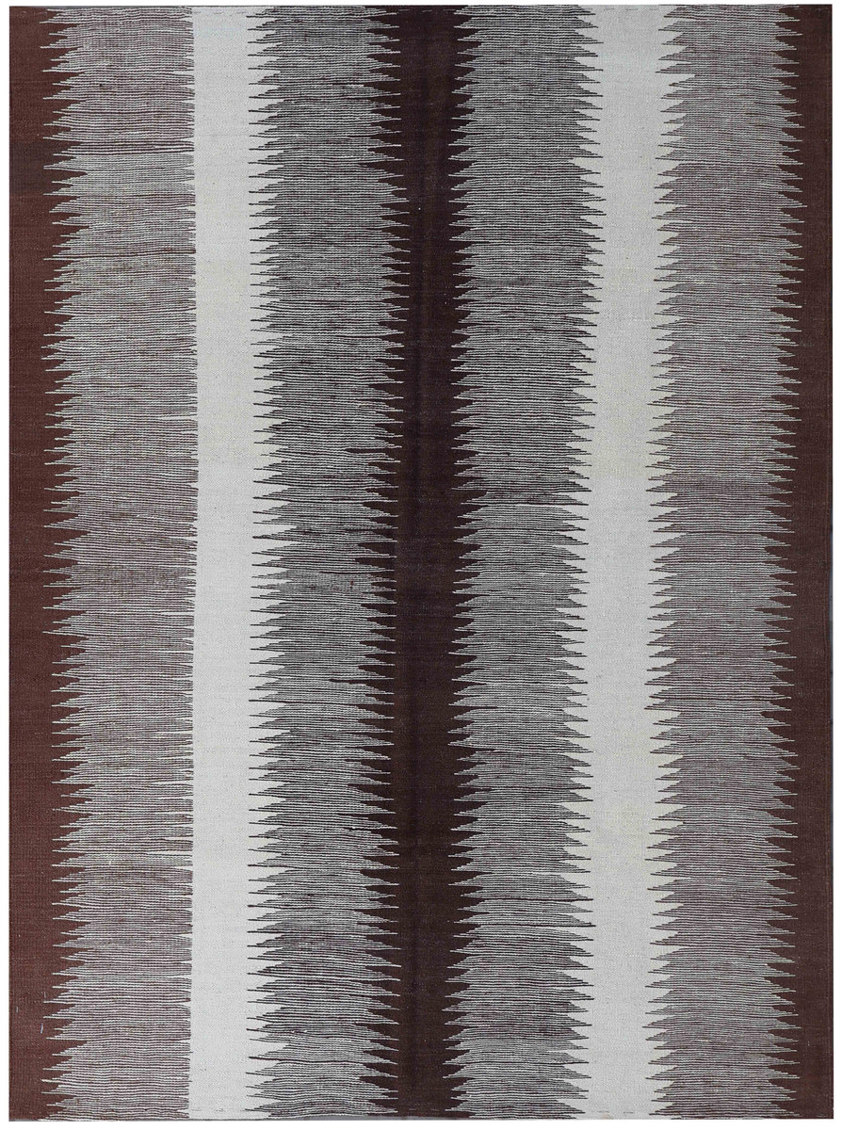
Long stripes organise this contemporary Afghan kilim, but their serrated edges keep the design from becoming static. Grey and cream bands sit beside deep brown lines, with small zigzag transitions creating a continual movement along their boundaries. The colour range is restrained; it is the changing widths and sawtooth outlines that supply most of the decorative interest.
Within the broader pale bands, fine horizontal changes of tone make the woven surface visible. Darker strips near the sides act as a quiet frame, reinforcing the length without introducing a separate ornamental border. The effect is linear at room distance and more finely textured nearby. Cream gives the darker brown room to register clearly, while grey provides a middle tone between the two. Flatwoven kilims form a wide textile tradition extending across several weaving regions. Unlike a knotted-pile carpet, a kilim constructs its surface through interlaced threads, making the junctions between coloured areas central to its appearance. Stripes are one of the most direct ways to explore that structure.
Here, the Afghan attribution accompanies a contemporary arrangement in which irregular edges give a familiar linear format renewed movement. Use the direction of the bands to reinforce the longer axis of a room or to connect a sofa with a pair of chairs. Brown leather, charcoal fabric and pale wood would all find a place in its palette. Keeping nearby patterns larger and simpler will allow the fine serrations to remain visible without making the scheme feel busy.