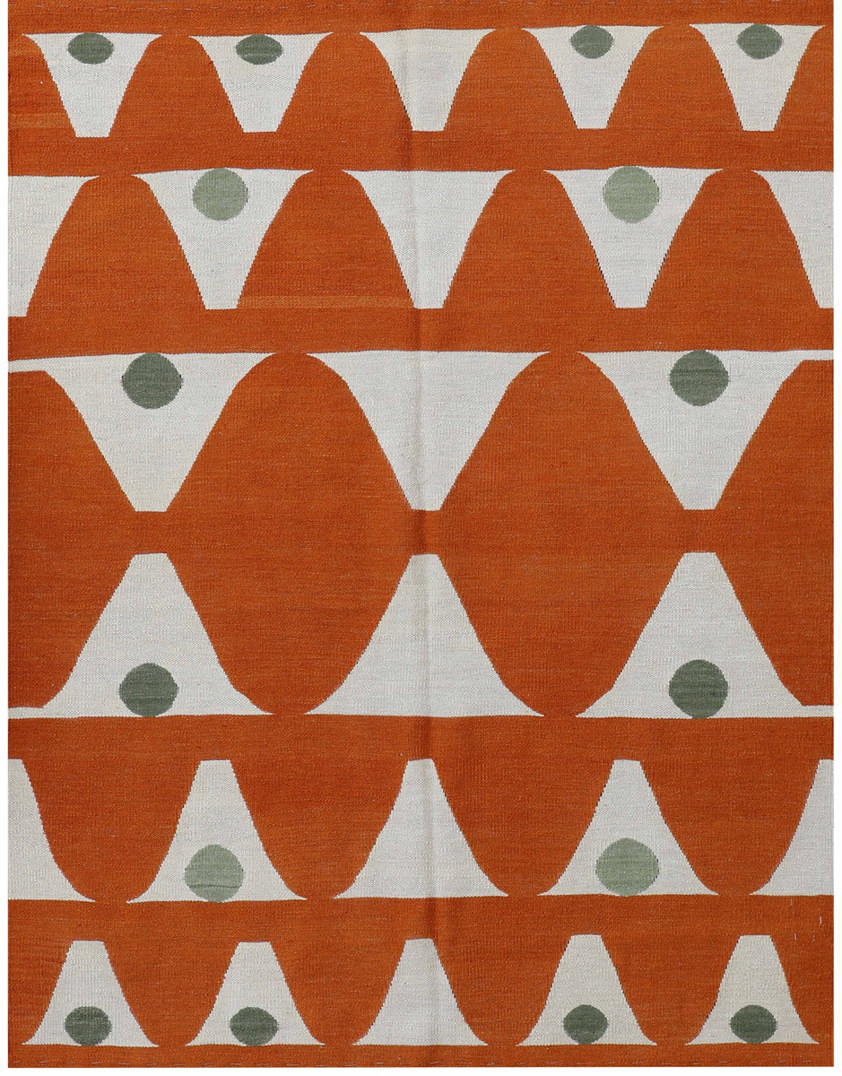
Olive circles punctuate the cream spaces of this contemporary Afghan kilim rug. Around them, broad orange waves expand and contract across horizontal bands. The upper sections use a quicker succession of smaller forms, while the middle opens into larger curves. A narrow orange edge finishes the composition, allowing the large shapes to carry the design without an ornamental border.
The cream areas alternate between downward points and broader upward wedges. Their relationship with the orange produces a changing rhythm from top to bottom. Fine horizontal shading remains visible inside the coloured areas, giving the flat surface a textile character rather than the uniform appearance of a printed graphic. The olive dots add a quiet natural accent within the stronger warm palette. Kilim construction forms pattern through coloured wefts crossing the warp. It creates a flat textile without a raised layer of pile knots. Although many Afghan kilims use small angular repeats, the same broad method can support a contemporary design built from larger colour areas.
Here, changes in scale and the meeting of curved and pointed forms provide the decorative structure that a traditional medallion or border might otherwise supply. This rug would sit well with plain cream upholstery, warm wood and a few olive accessories. A table with slender legs would leave more of the central waves visible. The orange could become the room's principal colour, with quieter curtains and walls maintaining space around the large, clearly drawn shapes.