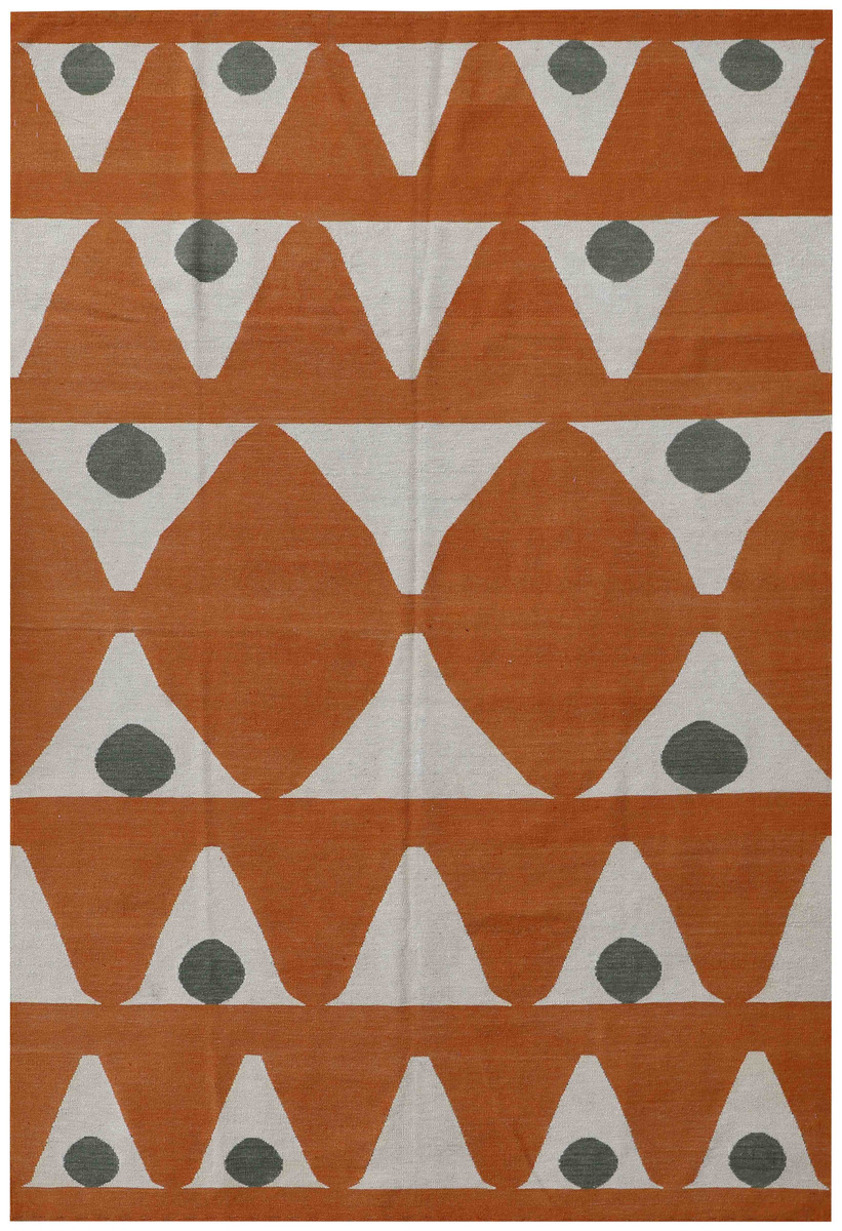
Cream pointed shapes punctuate the orange bands of this contemporary Afghan kilim rug. Their arrangement shifts in scale, with broad central forms and smaller repeats near the ends. Grey circles sit within selected pale areas, adding quiet points of contrast. The orange perimeter is narrow, keeping the emphasis on the interlocking shapes and the clear horizontal movement across the field.
The design is direct but has subtle surface variation. Fine changes of tone are visible within the orange, giving the larger areas depth without introducing further ornament. Cream provides a bright counterweight to the warm colour, while the grey details keep the palette grounded. The repeated curved boundaries soften the straight divisions between bands, producing a rhythm that feels balanced and easy to read. Flatweaving creates a kilim by interlacing coloured wefts with warp threads. Its pattern is carried within that structure rather than on a knotted pile. The method accommodates both intricate angular ornament and broad contemporary compositions. Afghan kilims therefore offer a wide decorative range, with this example placing particular emphasis on the relationship between colour, repetition and open pale space.
This rug would work well beneath a seating arrangement with clean-lined sofas and a simple table. Warm wood could complement the orange, while cream upholstery would echo the lighter forms. Grey accents in lighting or ceramics would connect with the circles. Leaving visible floor around the perimeter would emphasise the narrow edge and give the broad graphic bands room to define the space.