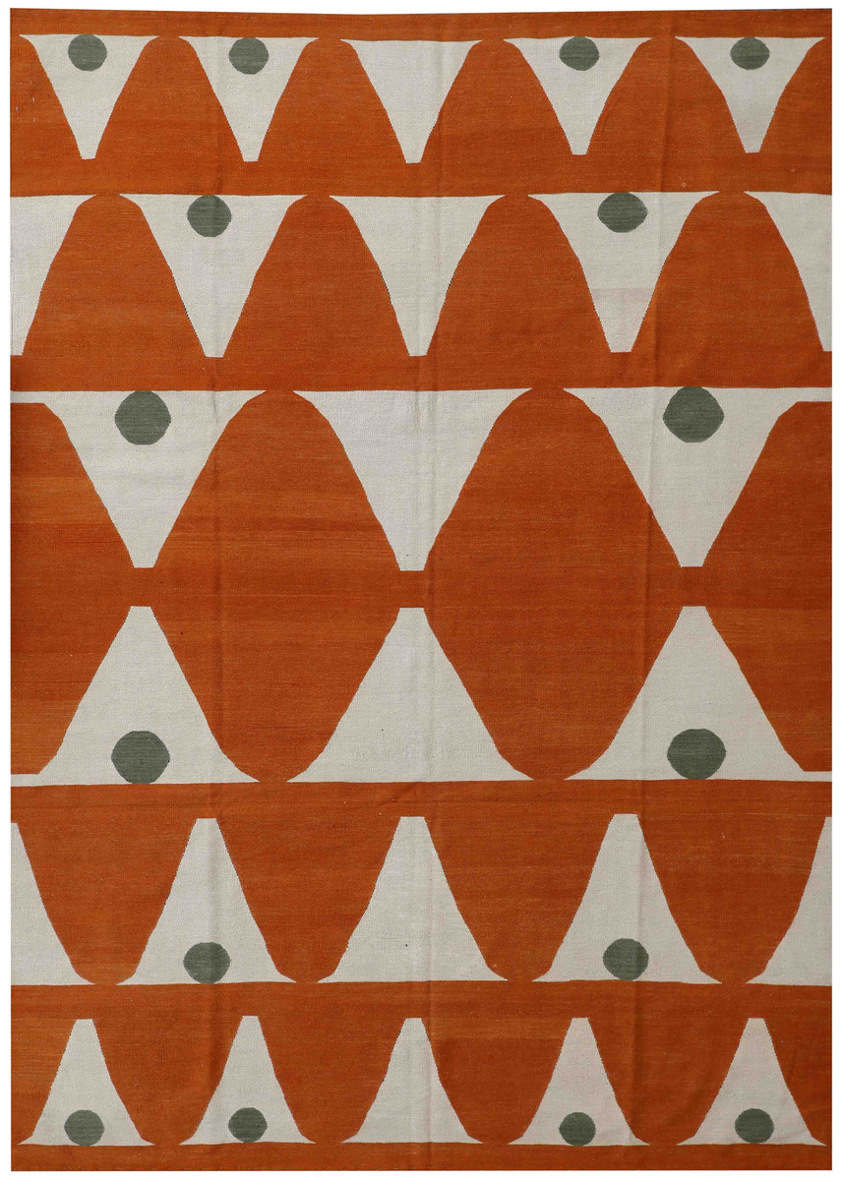
Broad orange shapes meet in a rhythmic sequence across this Afghan kilim rug. Their curved sides create cream pointed spaces, several marked with small grey circles. Horizontal bands organise the pattern, with larger forms through the middle and smaller repeats near the ends. The composition uses a limited palette and generous scale, giving it a clear contemporary character.
The relationship between filled colour and open pale space is especially noticeable. Orange supplies warmth and visual weight, while cream keeps the surface bright. The grey dots are modest accents rather than competing motifs. Fine horizontal variation within the flatwoven appearance adds subtle texture to the larger coloured areas. A narrow orange perimeter provides a quiet boundary around the repeated forms. Kilims are made by flatweaving, with coloured weft threads interlaced through the warp to produce the design.
They differ from carpets whose surface is formed by knotted pile. The structure can carry both detailed traditional geometry and simplified modern compositions. Afghanistan's kilim furnishings reflect that range, offering a textile format in which the arrangement of colour can be as important as an individual motif. This rug would suit a larger room with simple furniture profiles and relatively plain fabrics. Pale upholstery could connect with the cream shapes, and natural timber would complement the orange. A small grey accessory would reference the dots without adding another strong colour. Keeping the central bands visible around an open-legged table would allow the curved rhythm to remain apparent throughout the seating area.