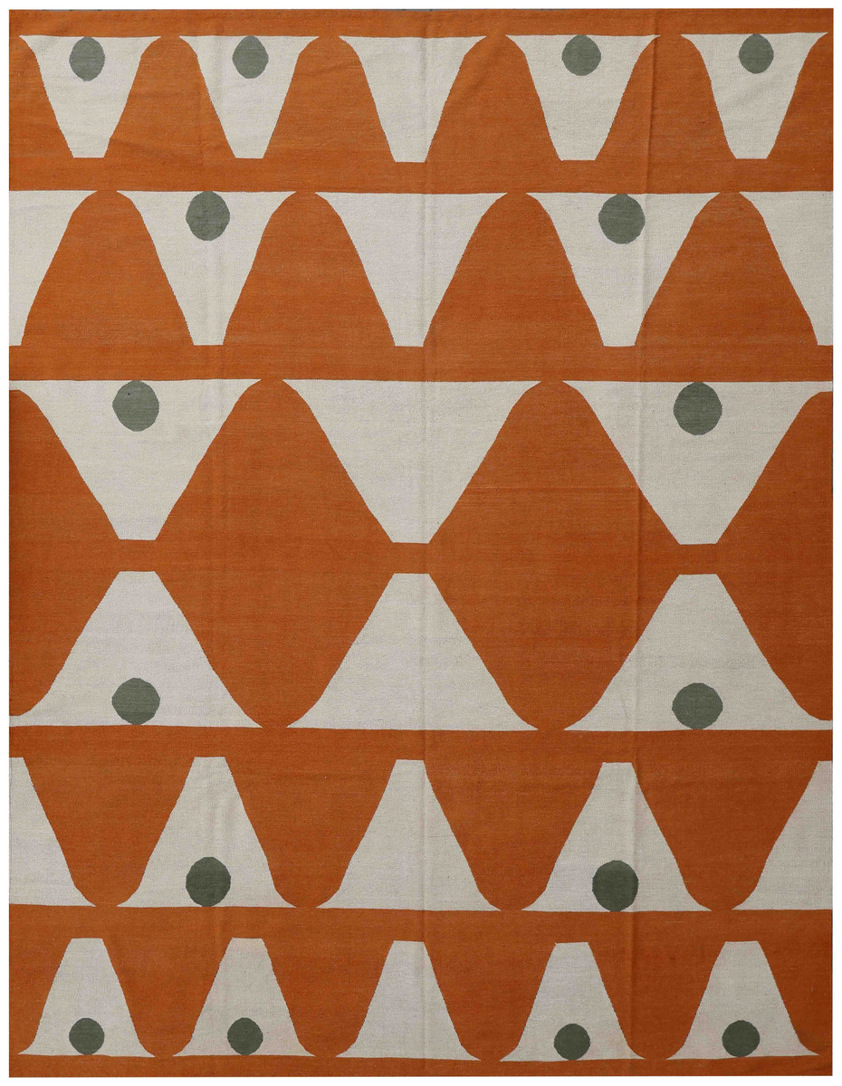
Large orange forms stretch across this contemporary Afghan kilim rug in broad horizontal bands. Cream tapered shapes interrupt the colour, with grey circles placed inside selected pale sections. The central bands are more expansive than the smaller repeats near the ends. At its generous scale, the design reads as a sequence of clear, interlocking shapes rather than a finely detailed ornamental field. The warm orange is balanced by substantial areas of cream. Grey provides a quieter accent and gives the repeated forms small points of focus. Fine tonal changes within the flat surface soften the broad colour areas, adding visual texture without complicating the drawing.
The narrow orange edge keeps the composition contained while allowing the pattern to reach almost to the perimeter. The kilim tradition is defined by flatwoven construction, in which coloured wefts interlace with warp threads to make the surface. This differs from the knotted pile of other carpet types. Although many flatweaves use inherited geometric motifs, the technique also supports larger, simplified arrangements.
This Afghan rug applies that textile structure to a contemporary pattern built around scale, spacing and repeated curved boundaries. The rug could establish a clear foundation for a spacious sitting room with plain sofas and open furniture. Cream upholstery would extend the lighter shapes, while warm wood would sit comfortably with the orange. Grey details in lighting or accessories could echo the circles. Allowing a substantial portion of the central bands to remain visible would preserve the design's broad graphic impact.