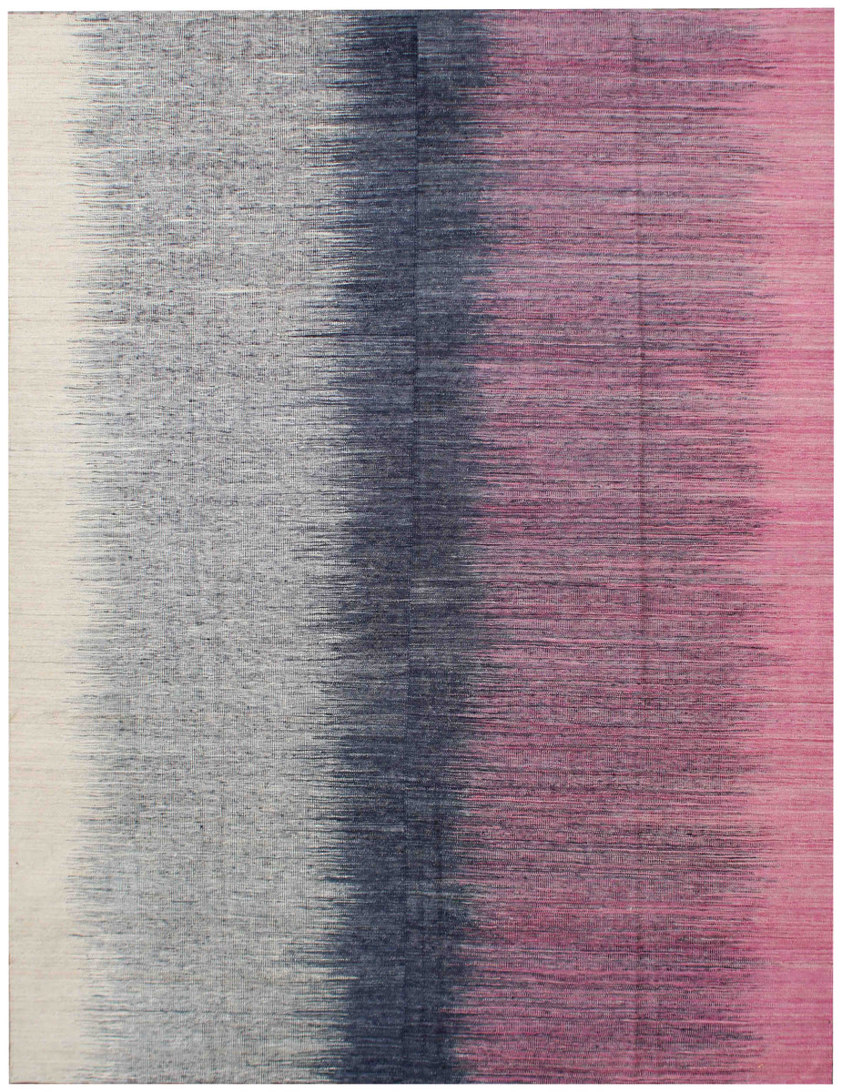
Fine horizontal streaks carry ivory through charcoal and into pink across this contemporary Afghan kilim rug. The pale area on one side gradually darkens towards a deep central passage, then opens into a broad pink section. Colours continue across the transitions in thin lines, giving the boundaries a softly feathered appearance. The field is unframed, so the changing colour becomes the whole composition.
This rug measures 340 × 260 cm, a generous size for an abstract design with relatively few large elements. It could gather a seating group without placing a medallion beneath the central table. Pale upholstery would relate to the ivory, while grey furniture could connect with the darker middle. Pink could remain a single strong floor colour or be echoed in one or two smaller objects. The surface has considerable visual activity at close range. Dark streaks cross into the pale area, and lighter threads of colour remain visible through the charcoal, creating depth within the broad zones.
From further away, those details merge into a more continuous transition. Afghan kilims form part of a long regional history of flatwoven furnishings in which line and colour are fundamental design tools. Contemporary examples can use those elements at a much larger scale than traditional repeated motifs. Here the emphasis falls on the movement between colours, giving this rug a painterly character while retaining a clear horizontal rhythm.