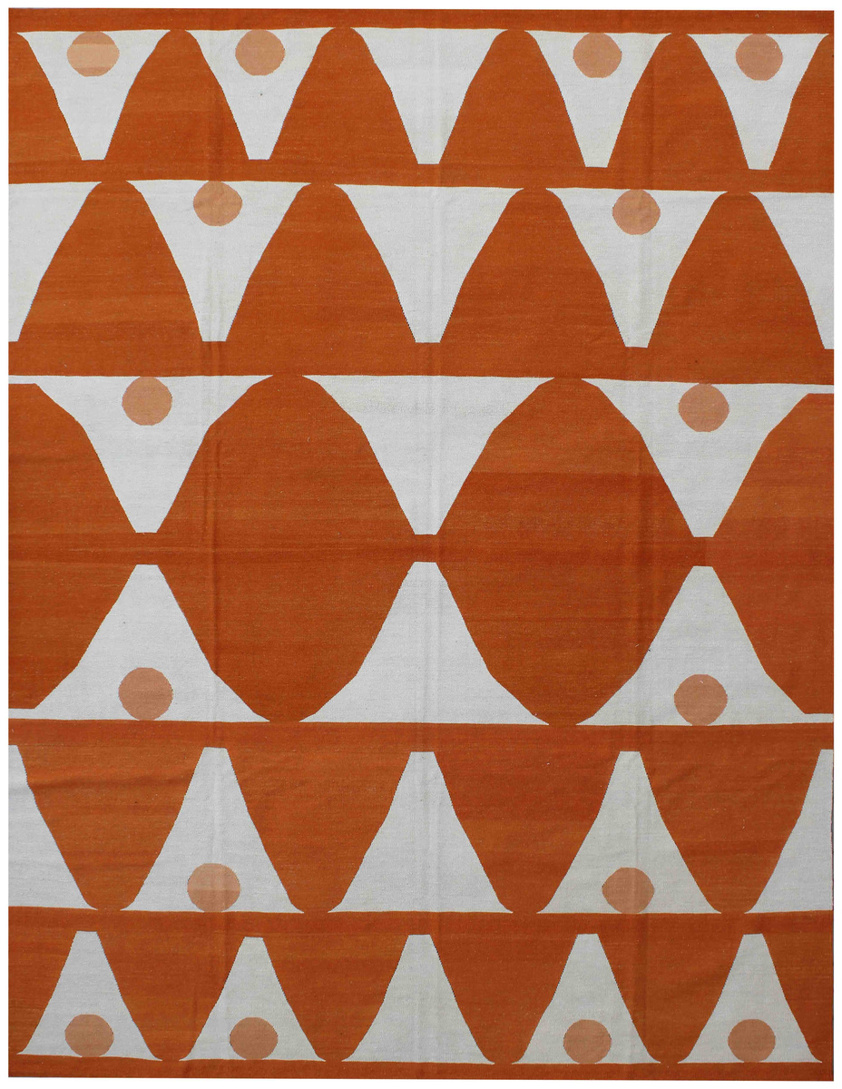
Small peach-coloured circles sit inside the ivory triangles on this rug. Orange forms broaden into rounded peaks between them, creating a succession of horizontal bands whose scale changes across the field. The widest divisions occupy the middle, while smaller repeated shapes close the ends. A narrow orange perimeter completes the rectangle without adding a separate ornamental pattern.
The circles make the composition less exclusively angular. Their softer colour is quieter than the orange around them, so the broad bands retain the main visual emphasis. Fine changes of tone can be followed within the coloured passages. Towards the ends, the closer repeat brings a different pace, allowing the broad central shapes to feel expansive without leaving the outer parts of the rug empty.
The generous 389 × 300 cm dimensions give the simple drawing considerable presence. A group of plain cream chairs could sit within the field while leaving the triangular rhythm apparent around the furniture. Warm timber would connect with the orange, and a pale peach fabric could refer to the circles. The large shapes would remain legible from across a substantial room. Kilim traditions in Afghanistan belong to the broader history of flatwoven household textiles in Central and West Asia. Repeated geometry can be developed through fine internal devices or, as here, through a few enlarged forms. This contemporary Afghan rug uses the spacing and proportions of those forms to create variation within a restricted palette.