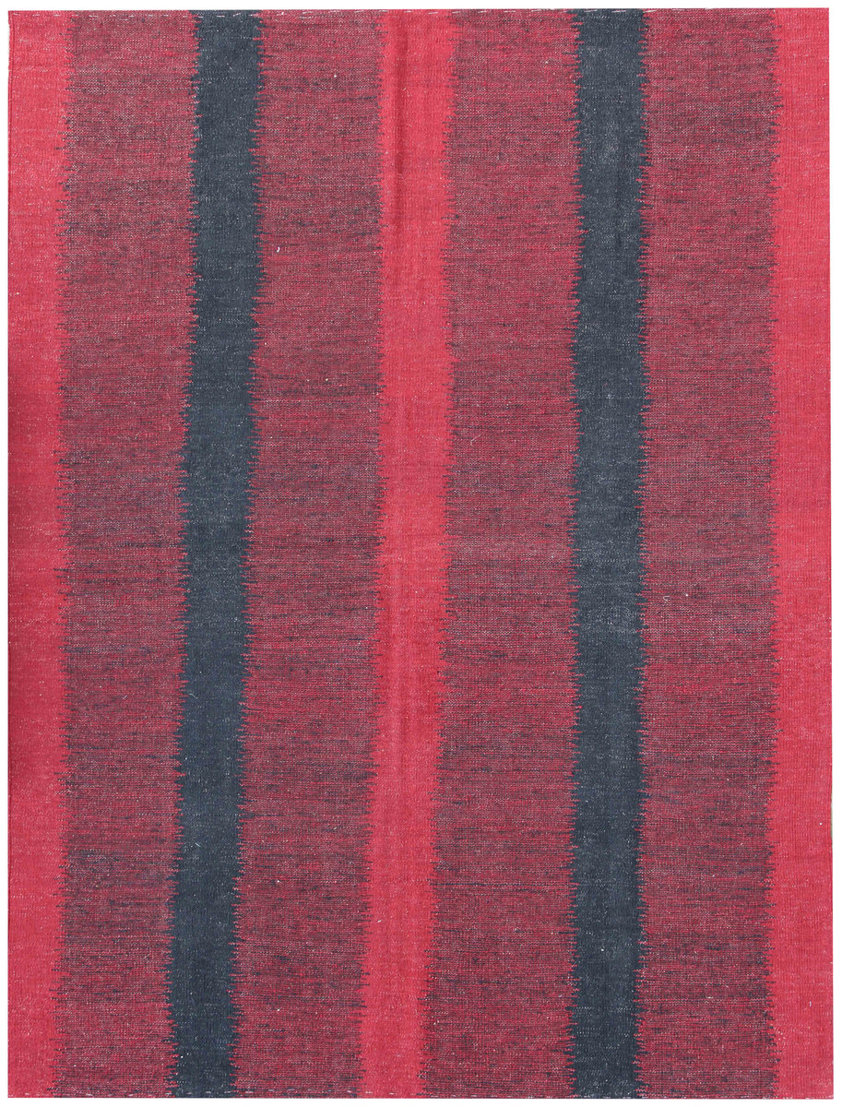
Narrow charcoal stripes interrupt the red field of this rug. The long dark bands vary slightly in width, and their edges are broken by many short horizontal marks. Red is strongest in the broader intervals, but grey lines continue through parts of those areas too. The result is a striped design with a much finer level of drawing inside its main divisions. The palette is direct and relatively concentrated. There is no pale border to soften the edge, and no central medallion to change the rhythm. Instead, the alternation of red and charcoal carries the composition from end to end.
Small changes in the density of the crosswise marks give different sections a lighter or darker appearance. Within Afghan flatweaving, repeated bands offer one of several ways to organise a rug's surface. Their effectiveness can depend on the balance between the width of a stripe and the space beside it. This contemporary kilim makes those relationships especially clear, using two principal colours and finely interrupted boundaries to give a straightforward arrangement additional depth.
Measuring 231 × 175 cm, this rug could provide a strong accent beneath a small coffee table or beside a bed. Dark grey furniture would relate to the narrow stripes, while pale walls would give the red a quieter surrounding setting. Its lengthwise direction could reinforce the room's longer dimension. The close linear marks would remain apparent in the exposed red passages near the furniture.