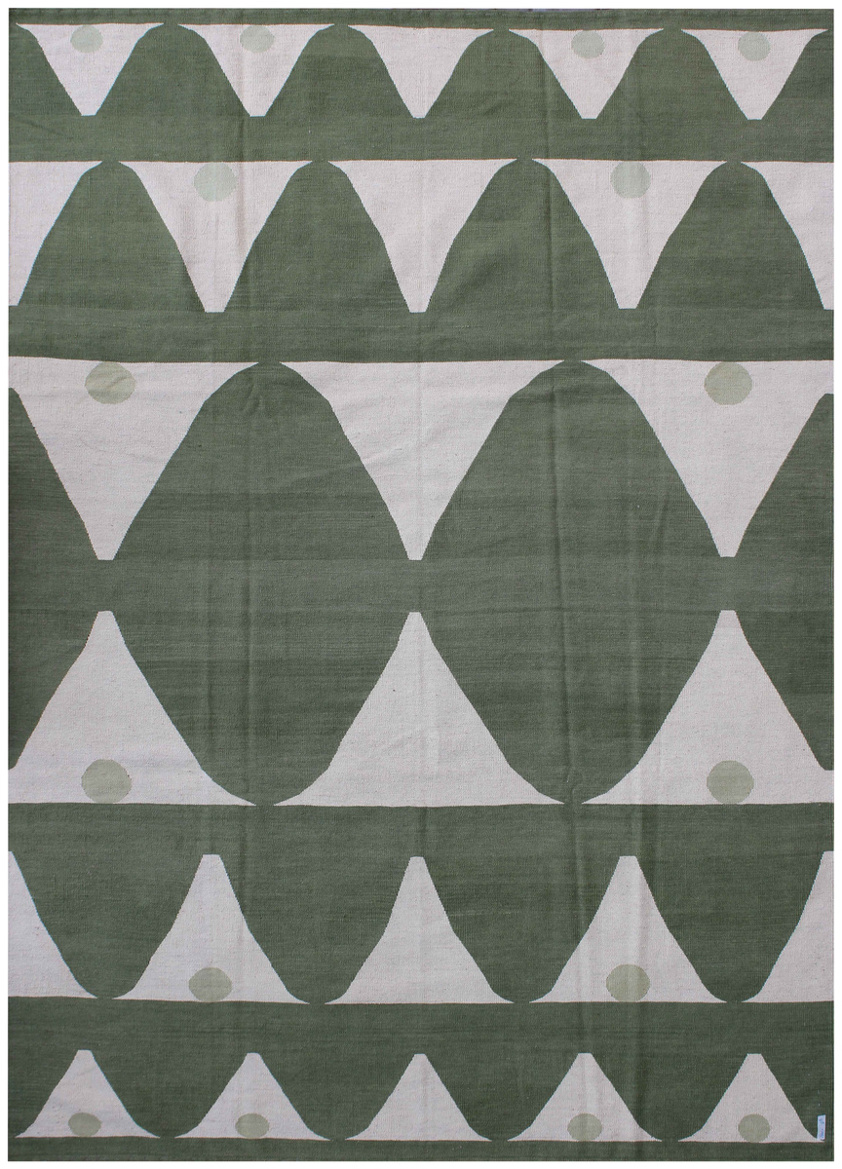
Broad green arches give this rug a definite, almost architectural rhythm. Pale pointed intervals fall between them, with small muted green dots occupying selected spaces. The rows change scale as they move through the field. The middle contains the deepest curves, while the end sections return to smaller repeating forms separated by narrow horizontal bars. Green has a restrained, greyish character, set against a pale ground with a faint warm note.
Fine changes of tone remain visible inside the larger shapes. Their outlines are clear enough to register across a room, yet the surface does not appear completely even nearby. The design reaches the sides without an additional patterned border. The geometric vocabulary of Afghan kilims can be developed through proportion as well as through the number of motifs used. Simple shapes, repeated at different sizes, create a strong relationship between one part of a textile and another.
This contemporary rug takes that approach with curves, points and circles, allowing its relatively limited palette to reinforce the larger arrangement. Measuring 347 × 248 cm, this rug would suit a generous seating area with simply shaped furniture. Light upholstery would answer the pale intervals, and warm timber would sit comfortably beside the muted green. A clear portion of the middle would show the full breadth of the curves. Towards the ends, the smaller rows provide a more compact rhythm around the furniture.