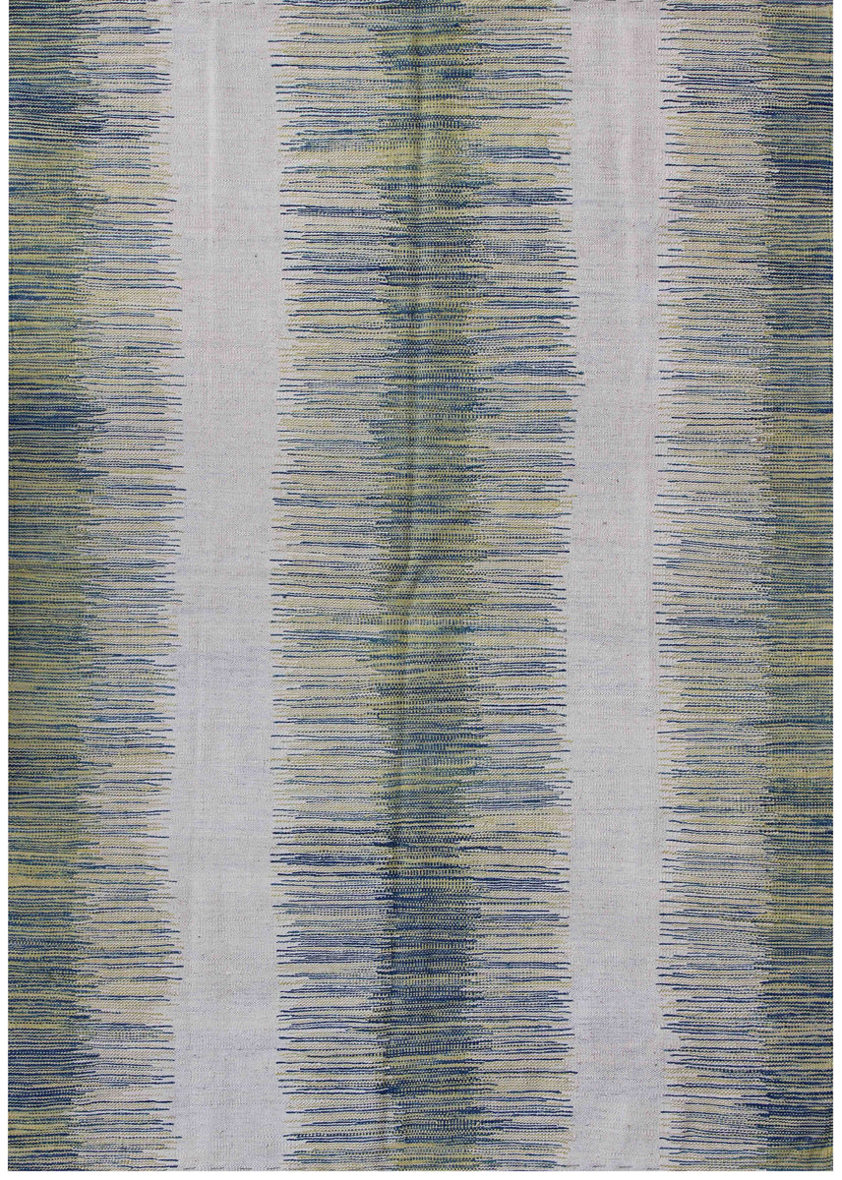
Light grey stripes cut through the finer blue and yellow drawing on this rug. The marks run crosswise, forming long coloured bands whose edges continually change. Dark blue gathers near the middle and outer sides, while short yellow lines lend a warmer note. The pale divisions remain broad enough to give the whole composition a light appearance. From a distance, the rug reads as a few tall stripes. Its smaller details become evident nearby: blue and yellow alternate in narrow passages, some ending quickly and others stretching farther across the light ground.
These changes supply a gentle visual texture without adding another motif. The field continues straight to the edges. The use of bands is common to many flatweaving traditions, including those represented in Afghanistan. A stripe can be decorative through its width, its colour and its relationship to the next one, even before subsidiary drawing is introduced. This contemporary Afghan kilim adds a finely interrupted boundary to that straightforward principle, making the smaller crosswise lines particularly important.
Measuring 235 × 165 cm, this rug could bring quiet pattern to a bedroom or a small reading area. Pale blue upholstery would relate to the cooler marks, and warm flooring could pick up the understated yellow. Its light stripes would remain useful beside darker furniture. The design rewards a setting where both the broad lengthwise arrangement and the tiny changes along its edges can be appreciated.