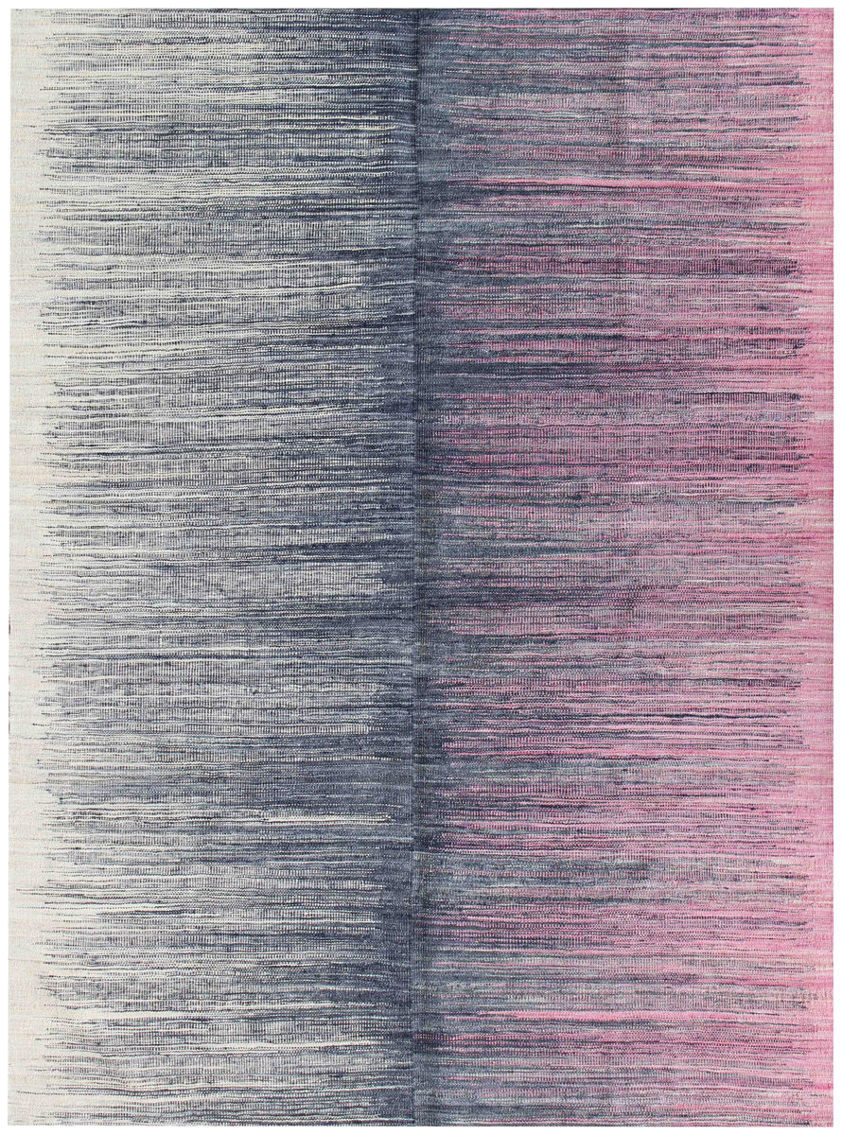
Pink occupies one side of this rug, set against a much paler grey passage and a concentrated dark section through the middle. Fine crosswise lines travel through all three areas. Their lengths change continually, sometimes extending well into the next colour. The effect is a broad division of colour with a far more intricate surface when examined nearby. This rug has no enclosing patterned border. Its dark marks reach towards the edges, where the field simply stops.
The pale left-hand area gives lightness to the composition, while the pink becomes strongest nearer the right side. Grey lines crossing that pink prevent it from appearing as an uninterrupted block. The kilim traditions of Afghanistan sit within a wider history of flatwoven domestic textiles. Their designs can develop from the repetition of simple lines and colour divisions, with small differences becoming significant across a larger surface.
This contemporary example places that emphasis on transition, allowing a few principal colours to overlap through an abundance of narrow horizontal marks. At 232 × 171 cm, this rug would fit a small living area or the floor beside a bed. It could introduce pink into a predominantly grey room without making that colour uniform across the whole rectangle. A chair set near the pale side would create a quieter interval beside the darker middle. Seen at floor level, the fine grey strokes would add detail to an otherwise simple furnishing scheme.