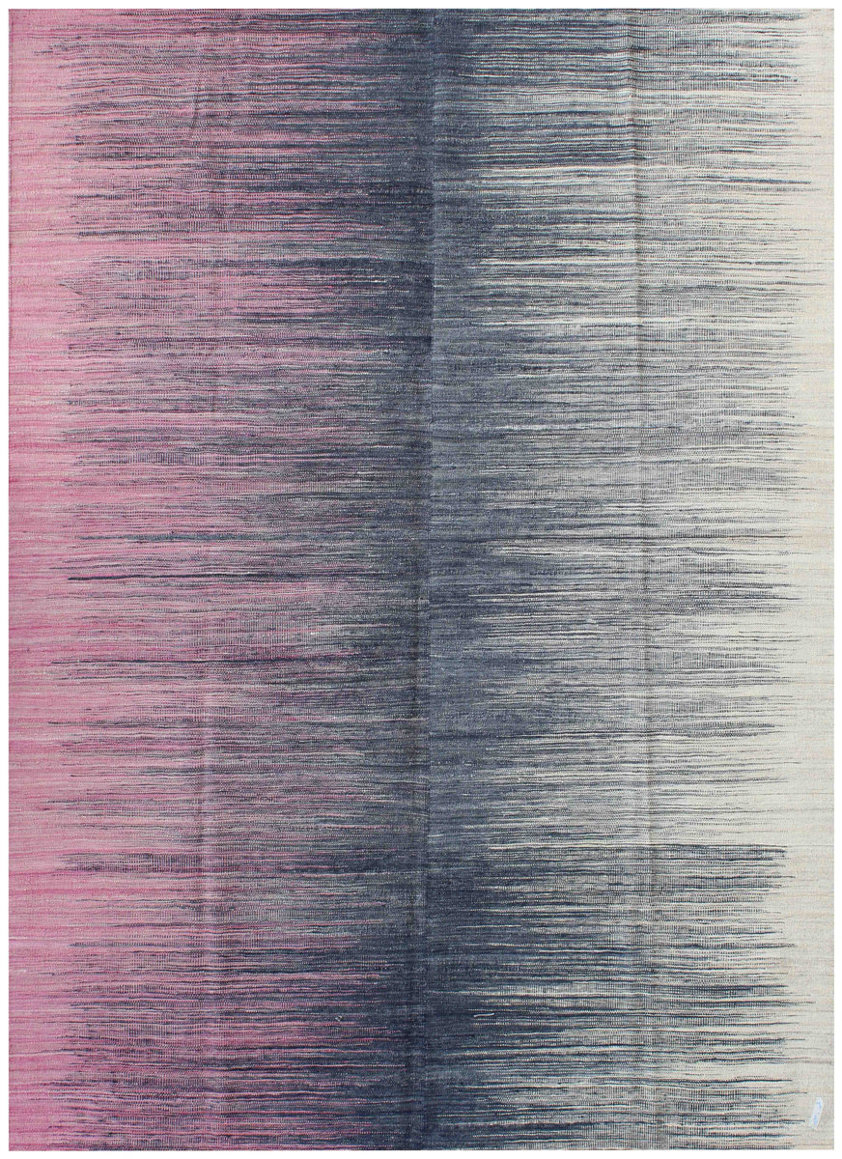
Pink passes into slate and pale grey across this rug, but the boundaries are far from solid. Countless fine horizontal lines extend from one colour zone into the next. At the left, pink holds the strongest warm colour; towards the middle, darker blue-grey becomes dominant. A pale right-hand section lightens the composition without forming a separate border. The short lines vary in length and strength. Some stop abruptly, while others reach well into the neighbouring colour, producing a softly interrupted transition. Viewed from a distance, the field reads as broad upright zones. Nearby, it becomes a much finer sequence of alternating dark and light marks, with the linear surface supplying its decorative texture.
Afghan flatweaving forms part of a wider regional tradition in which bands, repeats and geometric divisions are important design resources. A contemporary kilim can develop those elements without using a historical central medallion or floral frame. This rug places its emphasis on the meeting of colour areas, using simple divisions as the basis for a complex field of small horizontal strokes.
At 293 × 210 cm, this rug could bring colour to a bedroom with grey furniture or enliven a quietly furnished sitting area. Pink need only be repeated sparingly elsewhere. The pale zone could help connect the design with light flooring, while the dark middle would give weight beneath a table. Allowing more than one colour area to remain exposed would preserve the sense of transition across its width.