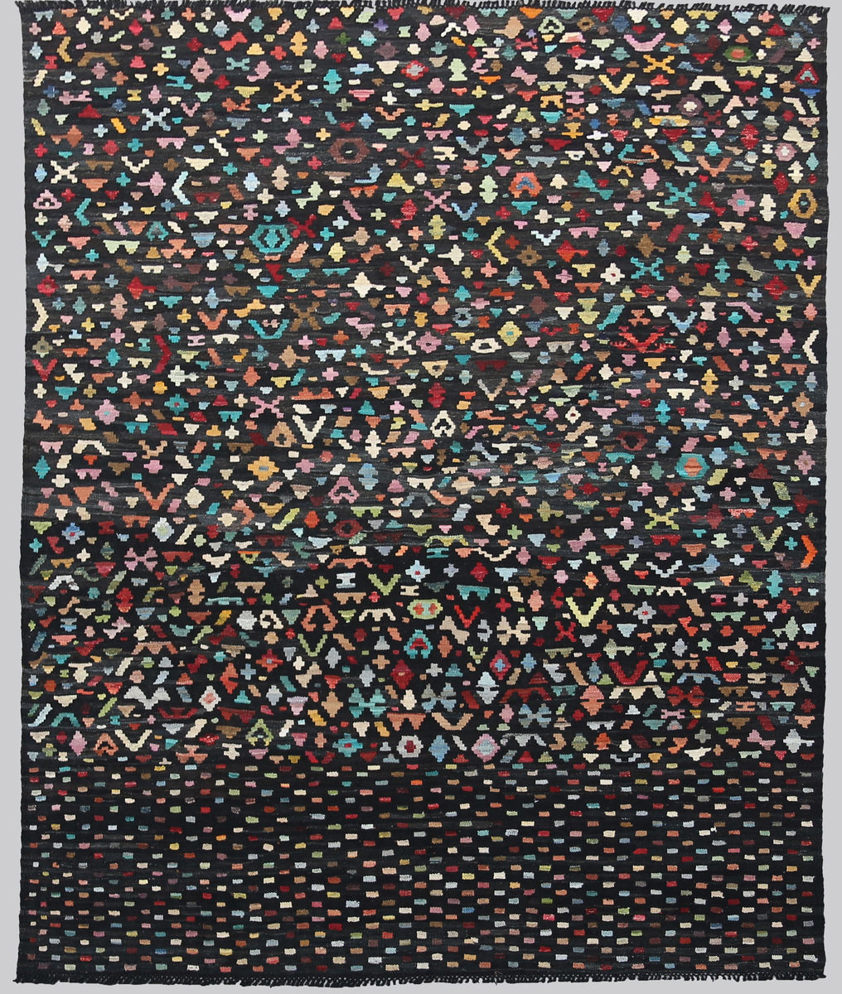
Tiny multicoloured motifs cover the dark ground of this rug. Diamonds, crosses, short zigzags and small angular forms appear in cream, red, turquoise, ochre, pink and green. Their sizes and arrangements change across the field, creating a close decorative texture. Towards one end, the larger little motifs give way to rows of much smaller coloured dashes.
The dark background makes the pale and bright marks particularly clear. Some groups form loose horizontal sequences, others gather into irregular clusters. The transition towards the dash-like end section is important: it changes the scale of the pattern without introducing a contrasting outer border or an entirely different palette. Afghan flatweaving includes a substantial range of small geometric ornament as well as broad banded designs. Within a kilim, repeated units can build an intricate field through modest changes of shape and colour. This contemporary example uses that vocabulary at a particularly fine visual scale, allowing numerous separate marks to create the main surface rather than a few dominant medallions.
At 237 × 176 cm, this rug could provide a richly detailed accent in a study or small sitting room. Plain furniture would let the finer motifs remain apparent, while a dark timber floor could connect with the ground. A single turquoise or red object would be enough to pick up the brighter details. Leaving the changing end section visible would show how its smaller dashes alter the rhythm of the whole composition.