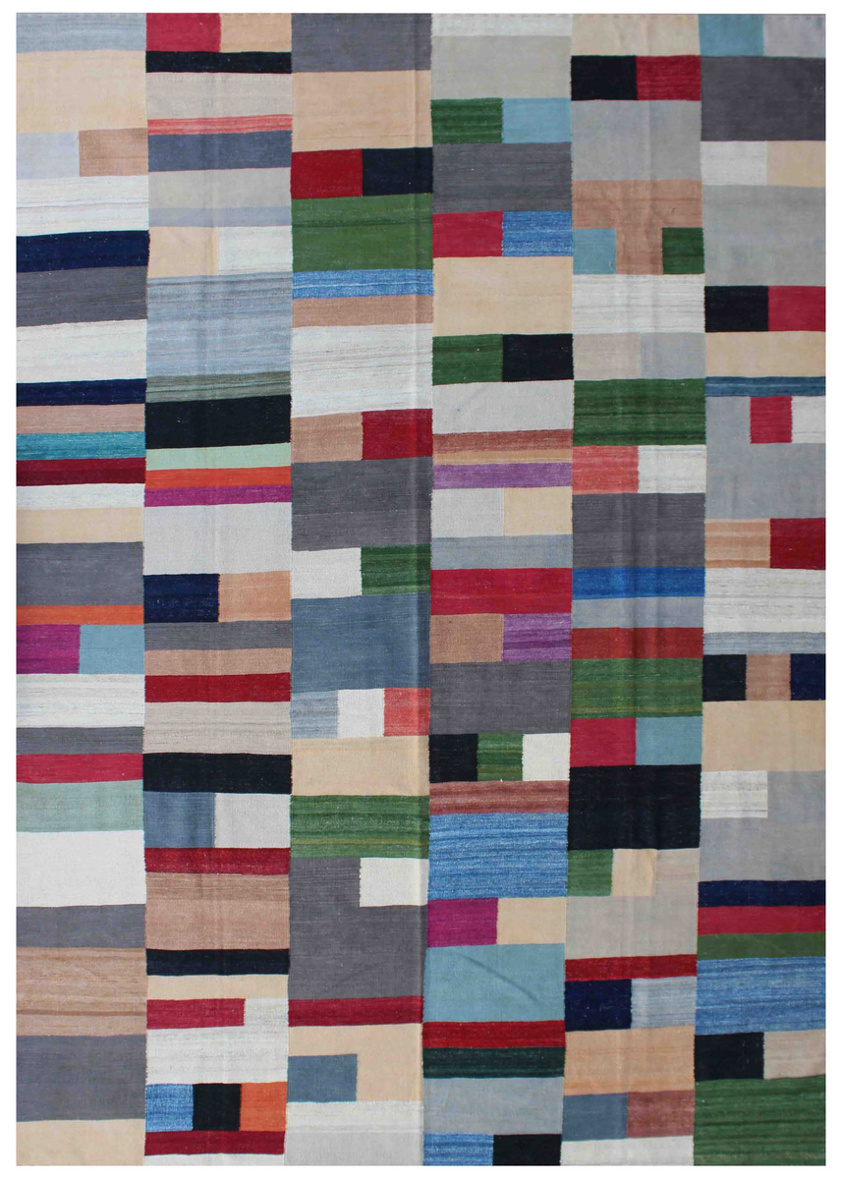
Unequal blocks and stripes create a busy but carefully distributed field of colour on this rug. Grey and ivory provide the larger quiet areas, while red, blue, green and deep navy supply stronger interruptions. Small pink, ochre and pale peach sections appear between them. Several long narrow bands run through neighbouring blocks, linking parts of the composition across its vertical divisions.
The scale changes continually. A broad grey rectangle may meet a fine red stripe, then a small green square or a cluster of pale bands. Some colours recur far apart, giving the arrangement a sense of connection without making it symmetrical. There is no outer ornamental frame; the changing blocks extend directly to the perimeter. Afghan flatweaving encompasses a substantial range of geometric design, from simple banded arrangements to more elaborate combinations of motifs. In a kilim, colour boundaries are closely related to the organisation of the woven surface. This contemporary rug takes that relationship into an abstract composition, using a wide palette and unequal proportions to develop the field.
At 377 × 268 cm, this rug would suit a generous room with relatively plain furniture. A pale sofa could relate to the ivory sections, while grey or navy cabinetry would connect with the larger dark blocks. The small bright accents offer several possibilities for nearby objects, but only a few need to be repeated. Leaving part of the long striped passages visible would show how they hold the shifting arrangement together.