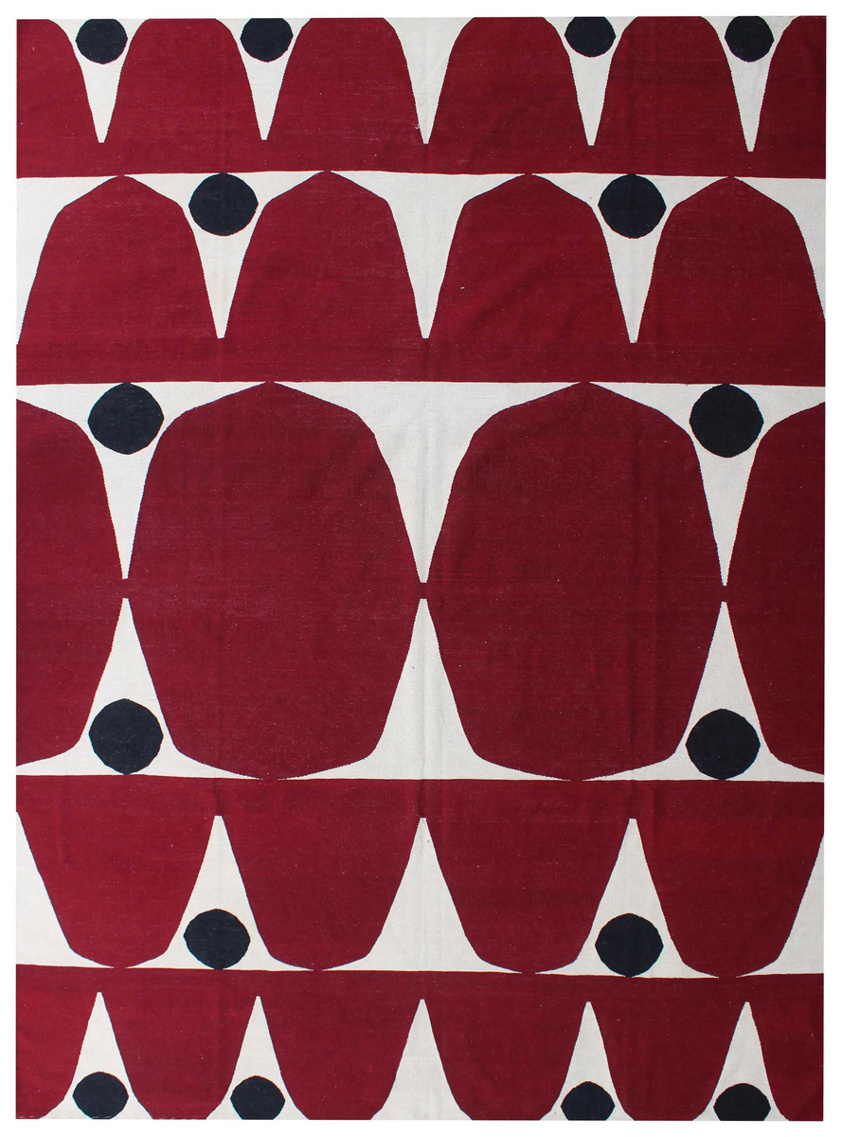
Red curves occupy almost the entire width of this rug, leaving sharp ivory openings between them. Small black circles sit near the tips of those pale spaces, creating a separate series of compact accents. The middle section expands into large paired oval forms, while the bands above and below use smaller, more closely spaced shapes. Fine horizontal lines of ivory distinguish several of the sections.
The simplicity of the palette makes the changes of scale especially apparent. Red carries the main visual weight, ivory opens the design, and black provides a few precise points of contrast. The edges of the curved forms are slightly faceted, giving the pattern a character that is less mechanical than a perfectly repeated print. Kilim is the name used for a broad family of flatwoven textiles with a long history across Afghanistan and neighbouring weaving regions. Geometry is particularly suited to the meeting of coloured areas within an interlaced cloth. Here, the familiar relationship between repeating shapes and open ground has been enlarged into a distinctly contemporary composition, with rounded forms replacing a finer angular vocabulary.
Measuring 393 × 311 cm, this rug needs enough visible floor area for its large central shapes to register. A generous living room with plain seating would provide that space. Ivory upholstery could relate to the pale divisions, while a dark table or metal fitting could echo the circles. Even beneath substantial furniture, the wide outer bands would retain their strong graphic presence.