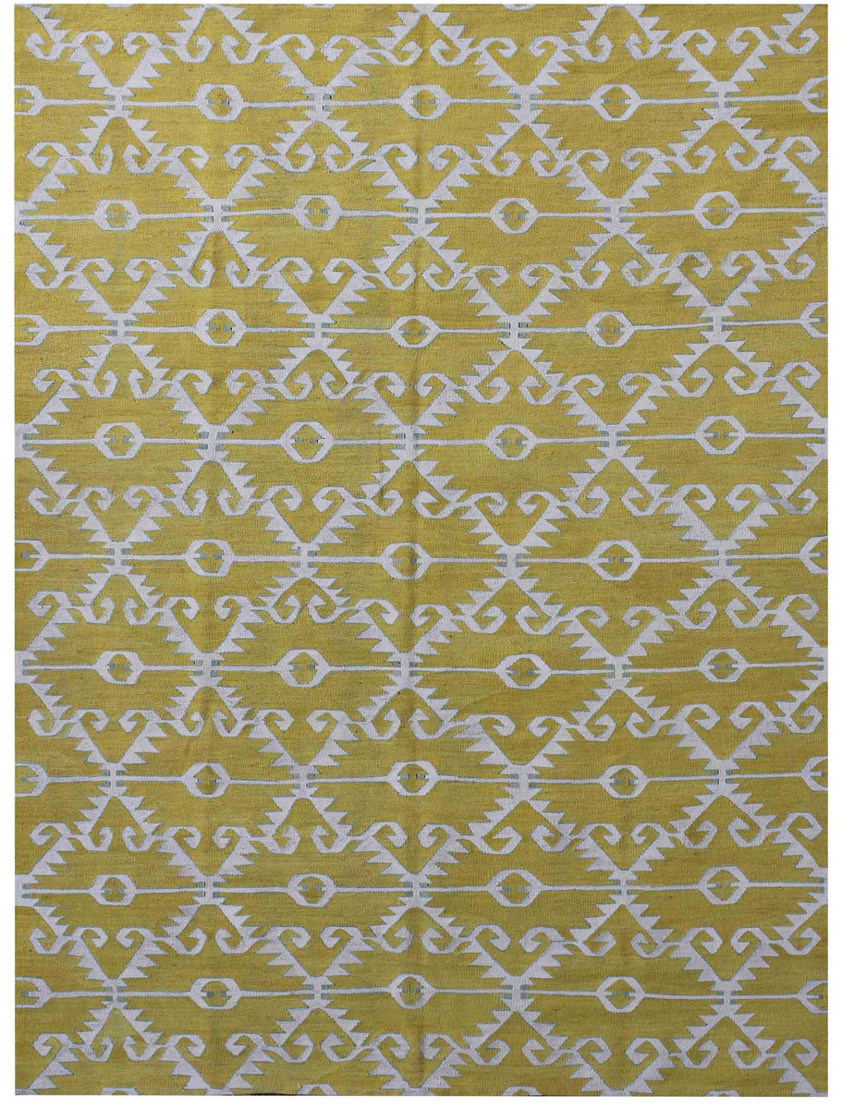
Mustard yellow gives this rug a warm, direct colour presence. Ivory hooked forms repeat in horizontal rows, linked by fine lines through small central lozenges. Between the larger shapes, pointed details create a secondary rhythm. The pattern reaches towards the edges without a separate heavy frame, leaving the contrast between yellow and ivory to carry the composition. The pale drawing is bold but not solid. Thin connecting lines alternate with broader hooks, and the mustard remains visible between each row.
Those changes of width give the repeat a lively pace, while the limited palette keeps it coherent. Small variations across the yellow add a little depth to the broad field. Kilim flatweaving has a long place within the textile traditions of Afghanistan. Its interlaced construction is well suited to geometric patterns, with stepped outlines and contrasting colours defining the surface. This contemporary rug uses a familiar hooked vocabulary in an especially bright two-colour treatment, emphasising rhythm rather than a central medallion.
At 295 × 198 cm, this rug could provide the main warm accent in a sitting room. Ivory upholstery would connect with the motifs, and dark timber would give the mustard a grounded setting. A small amount of blue or green elsewhere could provide a cooler counterpoint without repeating the rug's whole palette. Since the pattern continues throughout, a central table can cover part of the field while leaving its characteristic hooked forms visible on every side.