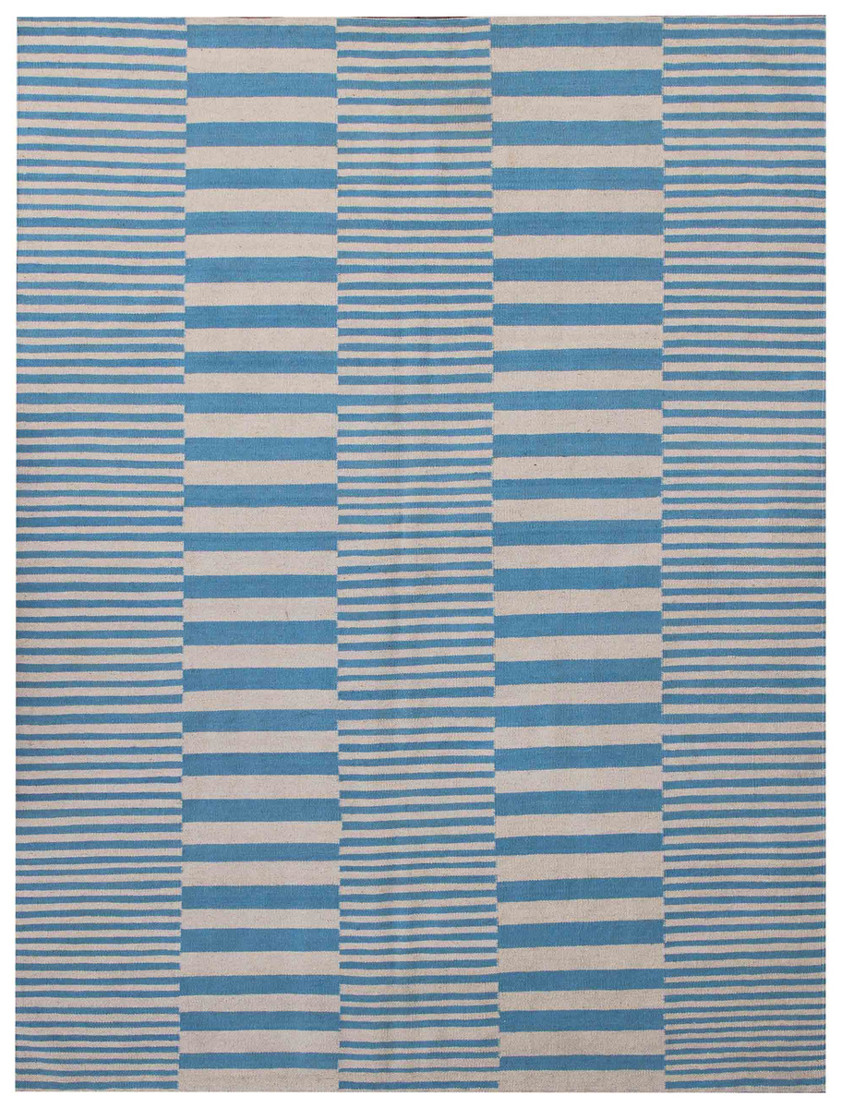
Blue and ivory stripes change scale across the five upright panels of this rug. Some sections use fine, closely repeated lines, while others open into broader bands of colour. Their horizontal edges do not align throughout, creating small interruptions where neighbouring panels meet. The composition has no separate border, so the changing stripe widths remain the principal decorative feature from edge to edge. The two-colour palette gives those differences unusual clarity. Rather than relying on several bright shades, the rug gains movement from the relationship between narrow and broad bands.
Ivory supplies lightness, while the blue has enough presence to define the panel structure when seen from across a room. Stripes are a longstanding part of the flatwoven textile repertoire, allowing interlaced colour to form a direct, adaptable pattern. Afghan kilims share that regional weaving heritage. This contemporary example develops the simple stripe through several related sections, showing how changes of proportion can create variety within a tightly restrained palette.
At 238 × 175 cm, this rug could suit a small sitting room, a study or an open bedside area. Pale timber would keep the blue fresh, while warmer wood would provide a gentle counterpoint. Plain ivory fabrics could connect with the light bands. A table can be positioned according to the room rather than a central ornament, since the stripe changes remain visible throughout the field and do not depend on one focal device.