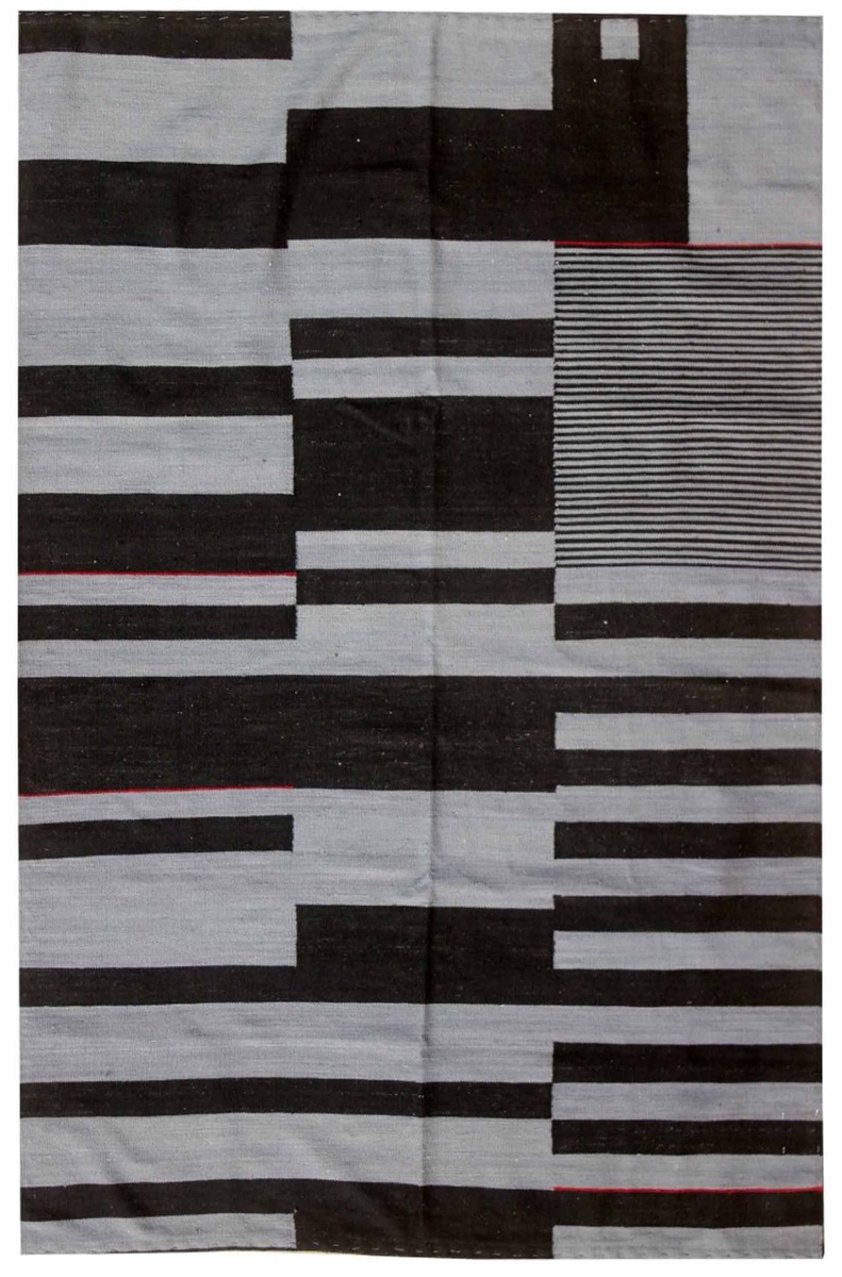
Interlocking bars of ivory and near-black give this rug a bold architectural quality. Some extend almost across the width, while others stop abruptly or meet a shorter block, creating a stepped arrangement. A finely striped passage introduces a different scale of line, and small red accents punctuate the otherwise restrained palette.
This rug is organised through horizontal movement, but the changing lengths prevent the bands from becoming predictable. Light and dark sections appear to slot into one another, with the edges of the blocks carrying the design right to the perimeter. There is no conventional floral border. The flatwoven kilim format makes the linear composition especially clear, with the pattern itself providing the decorative emphasis.
At 171 by 227 centimetres, this rug would make a strong focal point beneath a small seating arrangement. Furniture with slender legs would leave its interlocking structure visible. It could also work in a study with pale walls and dark shelving, where the ivory areas would keep the composition from feeling too heavy. A single restrained red accessory would be enough to pick up the small coloured marks. Kilims have a long place in the textile traditions of Afghanistan and neighbouring weaving regions. Their flatwoven surfaces accommodate bold colour divisions and geometric forms particularly effectively. This contemporary Afghan rug uses that capacity in an abstract arrangement, setting aside a central medallion in favour of an all-over relationship between bars, gaps and narrow stripes.