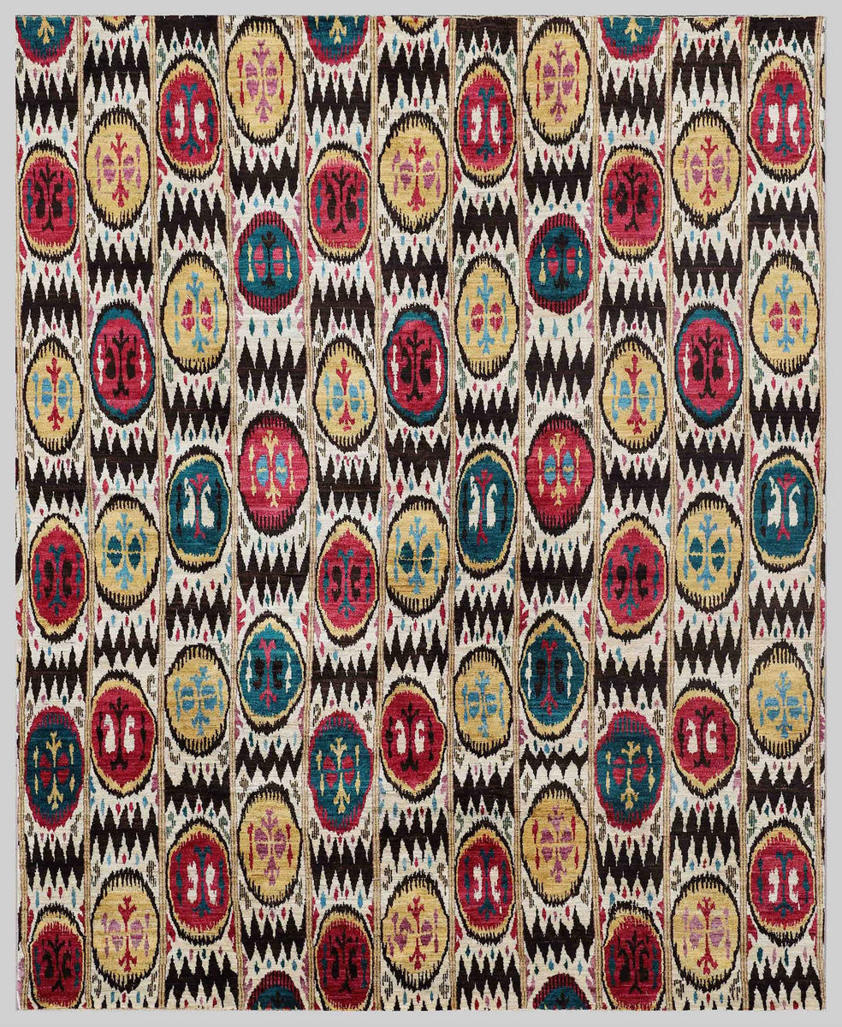
Teal, red and gold roundels spread across the broad field of this rug. Their centres contain small contrasting ornaments, from paired pale shapes to more angular blue and pink details. Dark outlines distinguish the rounded rims. The intervals are filled with narrow black-and-ivory points, producing a strong change between the full coloured forms and the sharper surrounding drawing.
The pattern remains active wherever it is exposed. Roundels near the edges are cut by the perimeter, suggesting a repeat that continues beyond the rectangle. Red supplies warmth, gold brings lighter accents, and teal gives several motifs a deeper cooler emphasis. The little internal ornaments reward a closer view without changing the overall rhythm. Ikat patterns have an important place in Central Asian textile history, particularly in fabrics associated with Uzbekistan and the Fergana Valley. Their bold shapes and characteristic edges have also inspired later decorative work beyond the original textile formats. This contemporary Afghan rug uses that design reference in an expansive repeating composition, with the surrounding points sharpening the effect of its oval devices.
At 297 × 241 cm, this rug would give a generous furniture arrangement a strongly patterned base. A plain ivory sofa could connect with the narrow pale intervals, while dark fittings would relate to the black drawing. The teal offers a useful connection to cooler upholstery or painted furniture. Several complete roundels would remain visible around a central table, retaining the variety of their smaller inner forms.