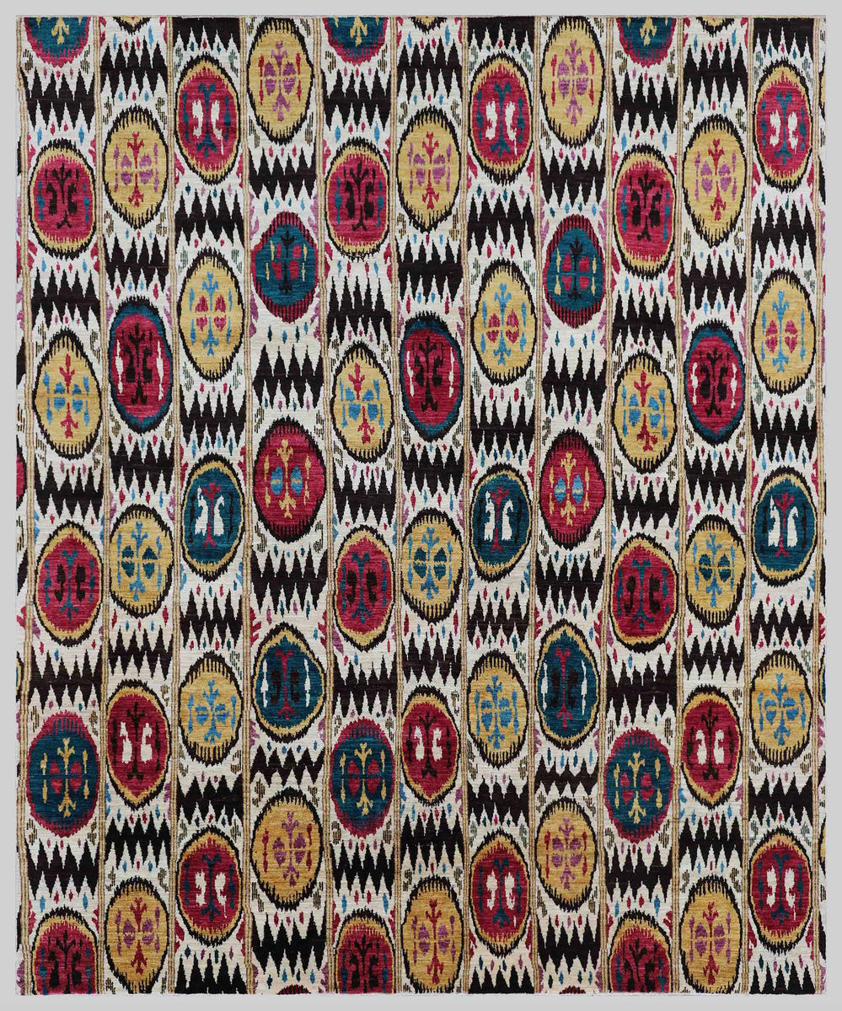
Colourful oval roundels sit within a sharply patterned black-and-ivory field on this rug. Red, gold and blue alternate around their rims, with smaller contrasting shapes inside. Between them, close rows of pointed black forms create a lively vertical movement. The repeat continues to the edges, giving the broad rectangle a consistently active surface. Ikat textiles are especially important within the decorative history of Central Asia, including Uzbekistan and the Fergana Valley.
Their characteristic patterned edges arise from yarns being bound and dyed before weaving. This Afghan rug uses Ikat as a design reference, translating the rhythmic shapes and lively boundaries into an enlarged floor composition whose larger coloured forms remain distinct within a closely worked background. The roundels give the eye recurring places to settle within the pointed background. Some are dark and red, others lighter and gold, making the colour balance shift across the field. Their softly broken edges are a useful counterpart to the narrow black points.
At 292 × 243 cm, this rug could supply the main pattern in a generous seating area. Plain furniture would let the repeat remain clear, and one selected red or blue accent could connect with its warmer or cooler motifs. The broad format leaves several roundels visible around a central table, preserving the changing rhythm even when part of the field is occupied.