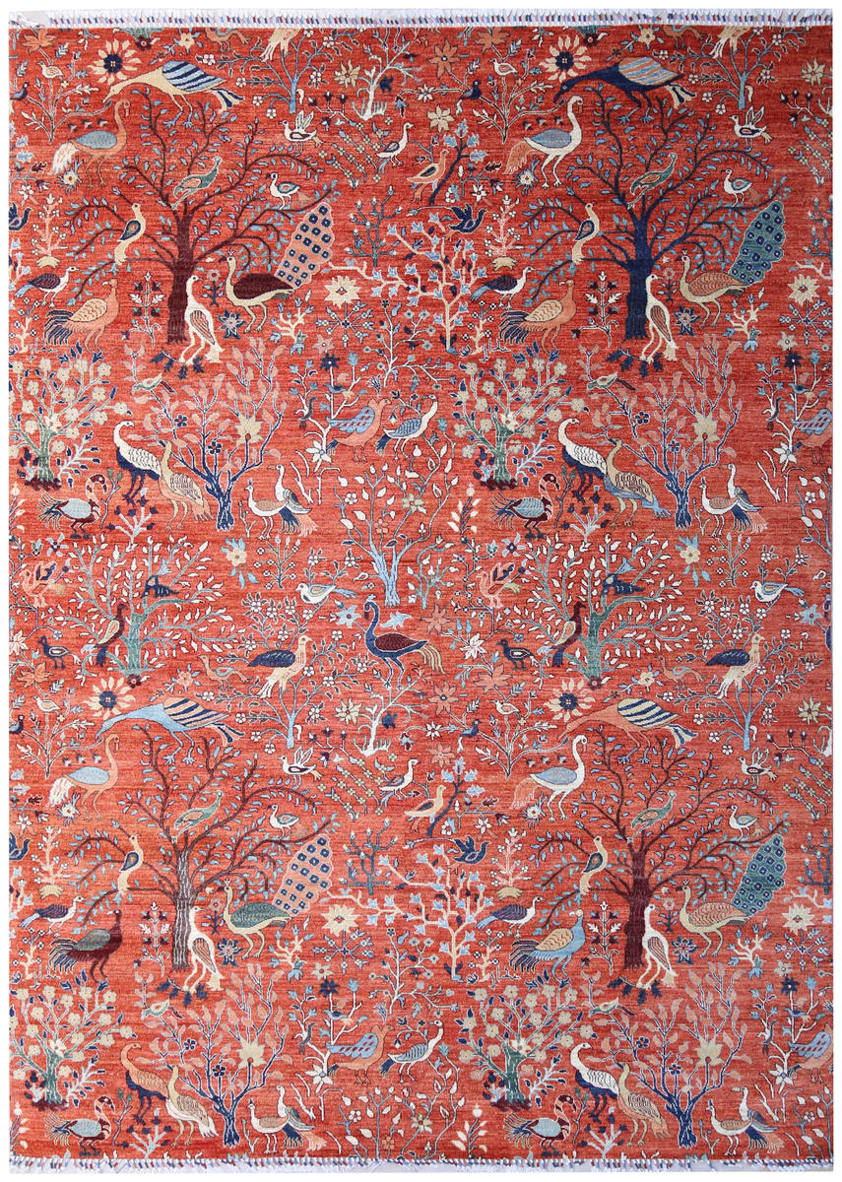
Birds and branching trees spread across the orange-red field of this Afghan Gabbeh rug. Cream, blue, green and muted yellow details distinguish long necks, patterned bodies and extended tails. Dark trunks support fine branches, while smaller plants and tiny flower-like units fill the intervening spaces. The figures face in different directions, creating movement throughout the field rather than gathering around a single central medallion. The birds vary in size and pose, giving each area its own pictorial emphasis.
Cream outlines remain clear against the warm ground, and blue introduces cooler accents among the richer red and orange. The pattern continues towards the edges without a broad separate border competing with the scene. Gabbeh has historical roots among weaving communities of Iran's Zagros region, where open colour fields and simplified figures were important design features. The name now appears across wider contemporary production. This rug is Afghan, and its detailed pictorial arrangement is considered within that broader design association without assuming the materials, pile structure or domestic uses of historical Iranian examples.
Its individual birds and trees provide the relevant visual character. Plain cream seating would leave the figures readable. Warm timber could complement the orange-red field, while blue ceramics would pick out cooler details. An open placement would preserve the changing birds and branching trees. Quiet surrounding fabrics would allow the smaller floral units to remain visible nearby, so the scene could be appreciated both as a broad field of colour and as individual pictorial details.