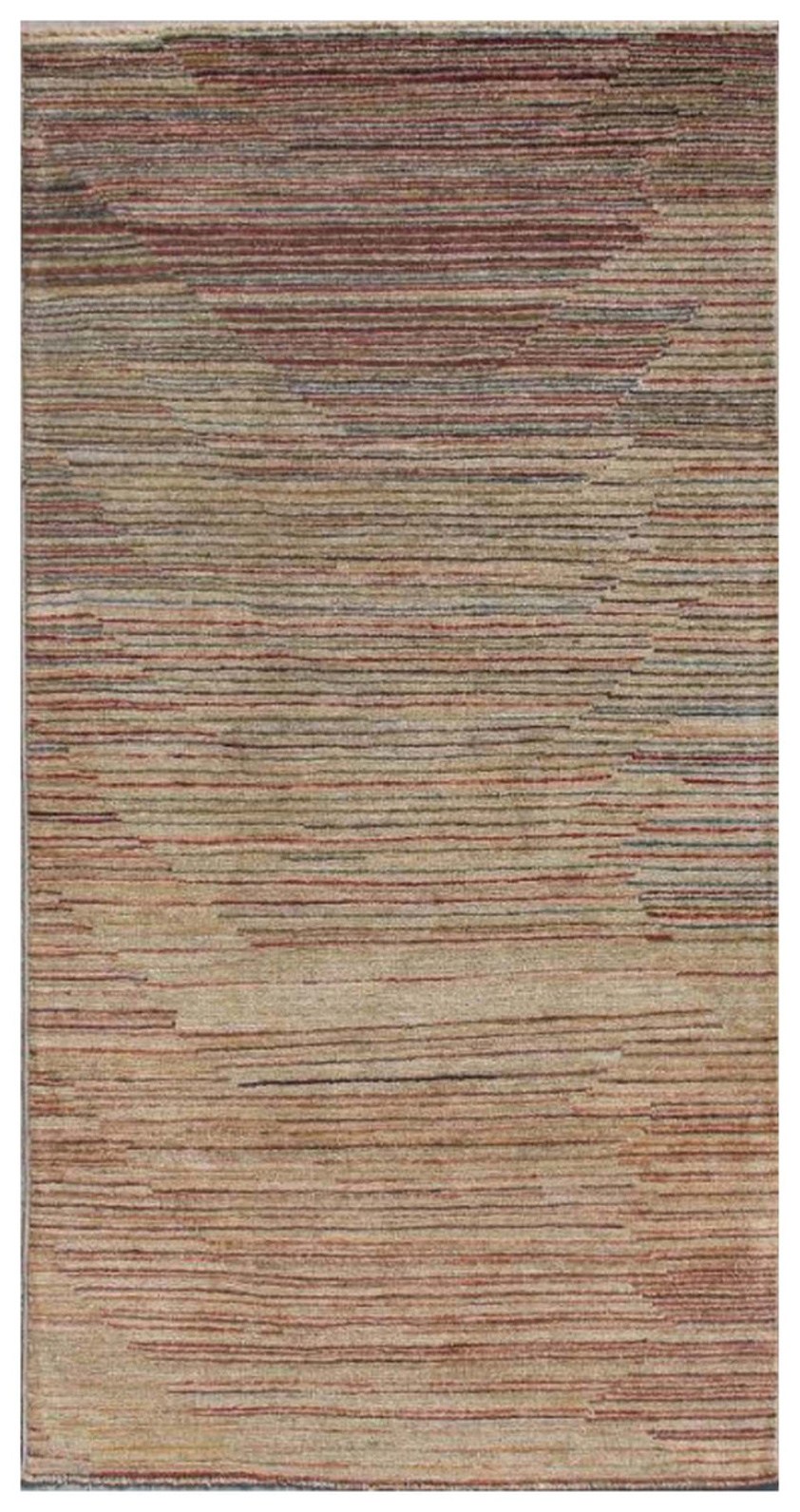
Closely spaced horizontal lines cover this contemporary Afghan Gabbeh rug, but their density changes considerably from one end to the other. Darker red, brown and charcoal marks gather towards the top. Below them, longer stretches of beige and warm stone give this rug a lighter, more open appearance. Slender grey-green lines run through both areas.
There are no large motifs to interrupt the stripes, so the eye follows these small shifts in colour and spacing. The result has more variation than a plain rug, while remaining quiet enough to sit beside patterned upholstery or an artwork with stronger colours. This rug’s relatively narrow shape lends itself to a bedside position or a small reading area, where the fine lines would be visible at close range. Gabbeh belongs historically to the rug traditions of western and southwestern Persia, including the Zagros region. Open areas of colour, simple imagery and informal geometry are familiar features of older examples.
Contemporary Afghan Gabbeh rugs draw on that interest in colour and directness of design, sometimes reducing the ornament to stripes such as these. Here, the broad change from darker to paler passages supplies the interest that a medallion or border might provide in another rug. The warmer tones would sit comfortably against oak or linen, while the charcoal threads of colour give a useful connection to darker furniture legs and metal fittings.