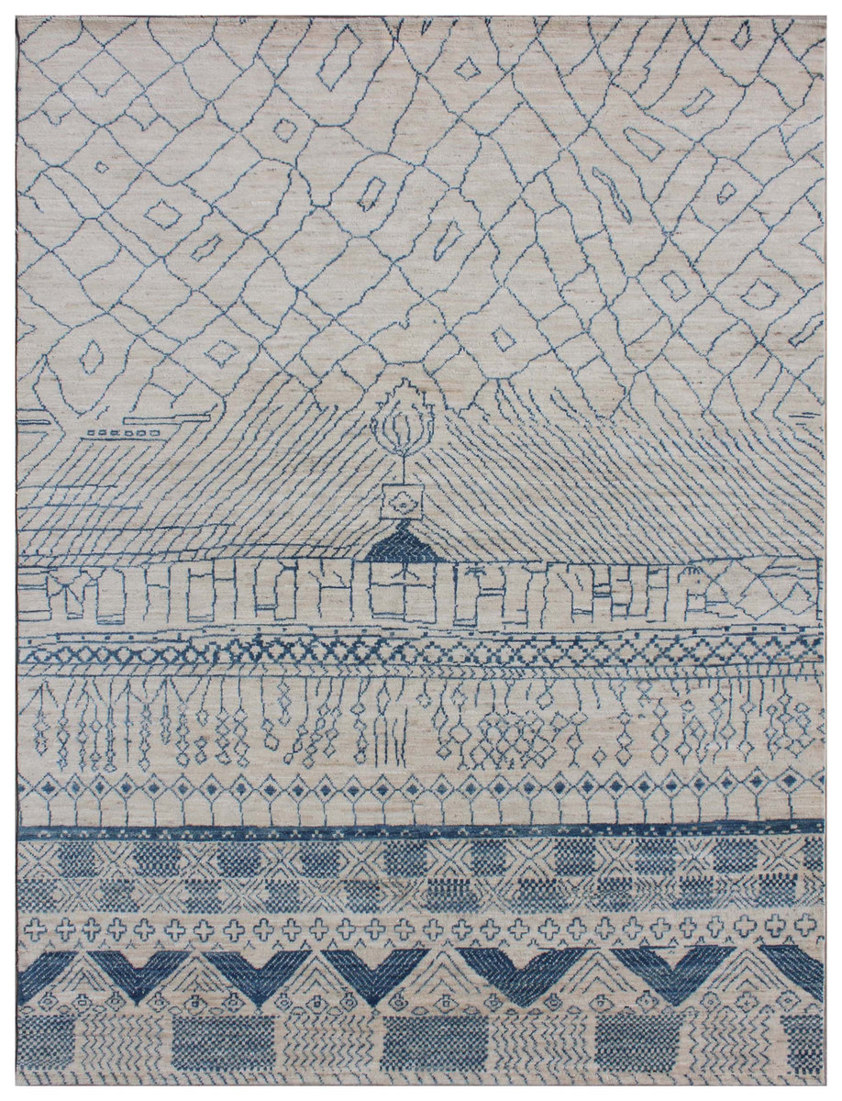
Loose blue latticework gives the upper part of this rug an open, informal character. The lines cross at varying angles, enclosing small diamonds and irregular spaces rather than forming a perfectly even grid. Lower down, the pattern changes into closely slanting strokes and a sequence of horizontal geometric bands. Darker triangles, little diamonds and crosshatched blocks create a more emphatic final section.
At 267 × 182 cm, this rug offers enough length for the transition between these different areas to be appreciated. It would suit a sitting room where the quieter portion could extend beneath furniture and the more detailed end remain exposed. Cream upholstery would connect with the ground; blue accents could pick up the linework without needing to repeat the whole design. Berber style is a design reference to the textile traditions of Amazigh communities, with Moroccan Atlas rugs providing well-known examples of expressive geometric drawing. Here, that reference is interpreted in an Afghan rug with a contemporary, asymmetrical arrangement.
The emphasis is on changing line and spacing rather than a central medallion or enclosing floral border. The restrained palette keeps those changes coherent. Thin upper lines have a different visual weight from the dark lower triangles, yet the shared blue links them. Natural wood, textured linen and simply shaped furniture would give the pattern a quiet setting. A clear area around the lower edge would show how the little motifs gather into broader bands.