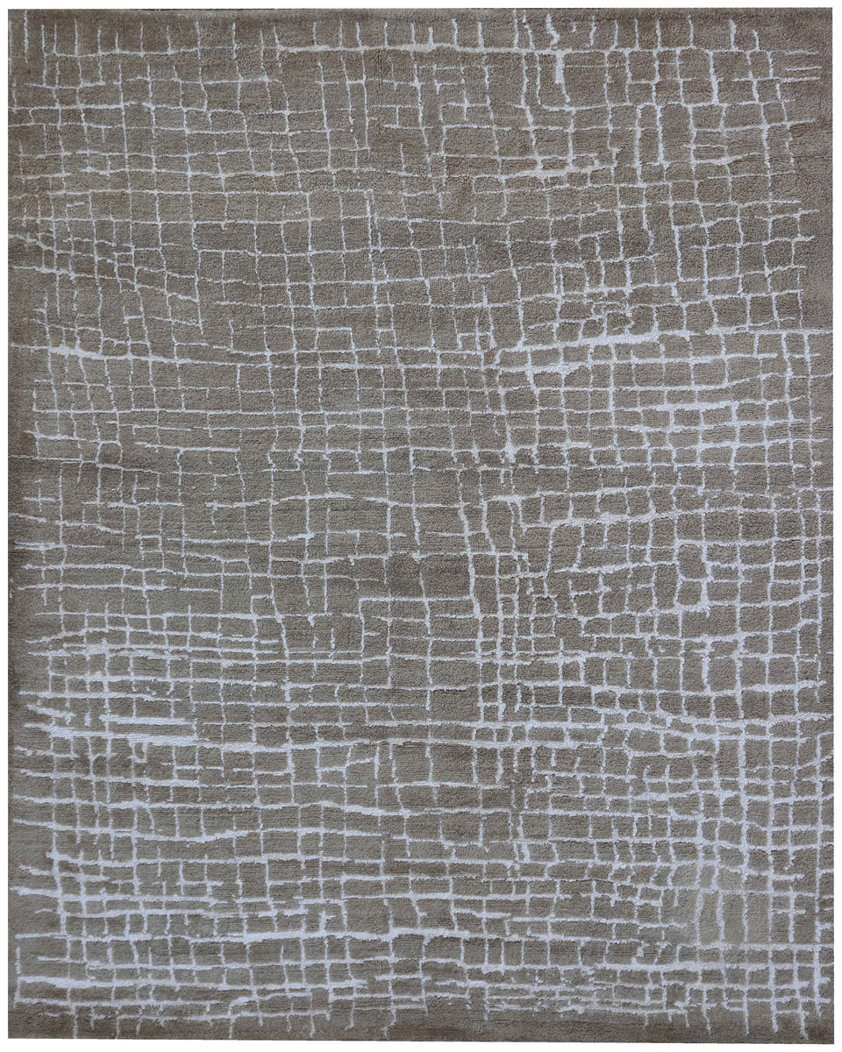
An irregular ivory grid spreads across the taupe field of this rug. The lines form rectangular compartments of changing proportions, some narrow and closely grouped, others wider and more open. Small shifts of direction keep the network from becoming a precisely ruled pattern, giving the drawing a quietly animated character. This rug uses a particularly restrained balance of colour. Taupe remains visible between the fine lines, with subtle tonal variation adding detail beneath the grid.
The 250 by 302 centimetre format would suit a generous seating area, where the network could continue to register around a table. Plain upholstery would let the changing compartments remain the principal pattern. Within contemporary Afghan Berber style designs, freely handled geometry can take many forms beyond the familiar diamond lattice. Here the rectangle supplies the basic vocabulary. The interest comes from changes of width, line spacing and alignment, allowing a limited set of elements to create a field that is consistent without being uniform. Warm timber would relate to the taupe, while ivory curtains or cushions could pick up the drawing.
Darker furniture would bring the pale network into clearer focus. Seen from a distance, this rug offers a quiet neutral foundation; nearby, the many small changes within the grid become more apparent. It would reward a room where part of the broad middle remains uncovered, preserving the relationship between the open compartments and the more densely lined passages.