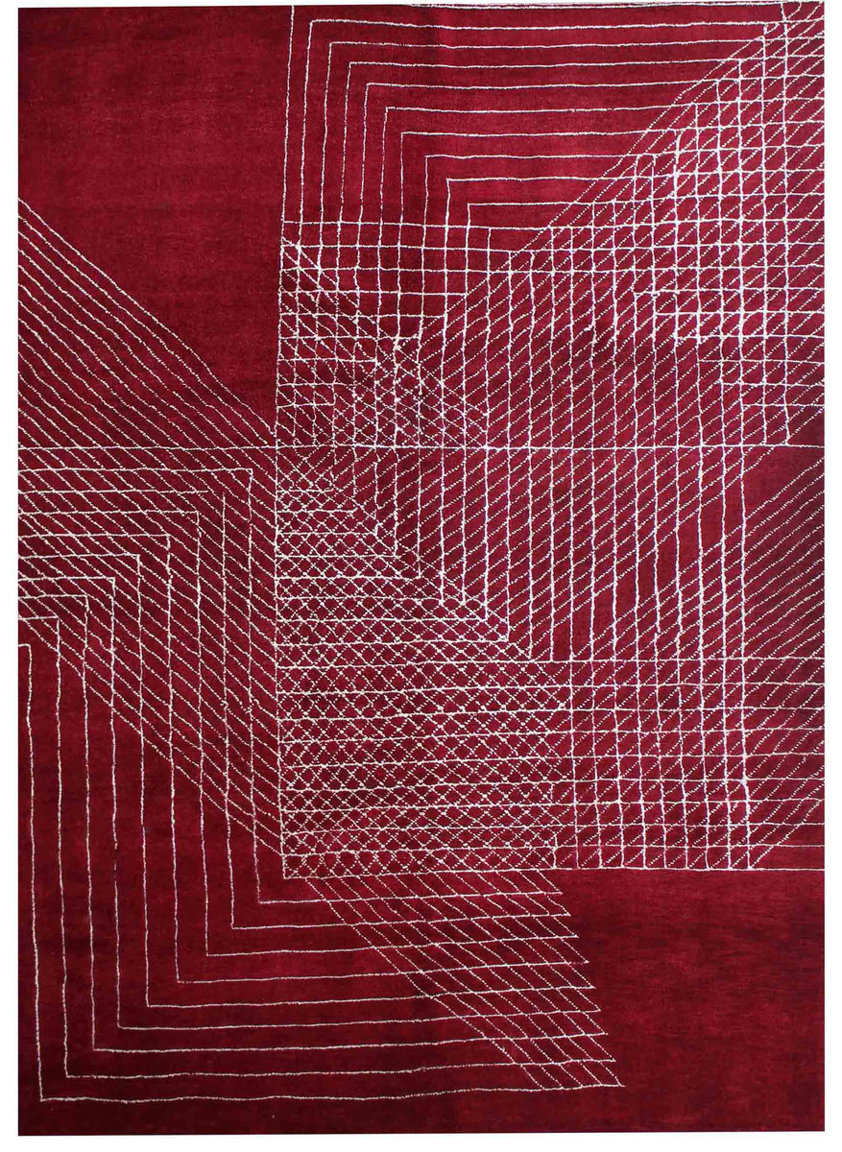
Fine pale lines turn across the red field of this rug, creating nested right angles and overlapping grids. Some groups remain widely spaced; others cross closely enough to form denser light passages. Open red areas separate those concentrations, keeping the composition varied across the long rectangle. This rug has a strong architectural character despite its fine drawing.
The stepped outlines provide the main structure, while their intersections introduce smaller patterns within it. The red is deep enough to give the pale lines a clear setting, with subtle tonal variations adding movement beneath the geometry. No floral frame interrupts the arrangement at the edges.
At 194 by 303 centimetres, this rug could suit a long seating group or an open study. A simple table would leave the intersections as the main nearby detail, while cream upholstery could connect with the pale drawing. Warm wood would relate comfortably to the red. The contemporary Afghan design uses repeated linear elements as an entire field, giving traditional geometric organisation a more expansive, abstract treatment. Viewed from a doorway, the larger stepped shapes are immediately apparent.
Nearer the surface, individual lines can be followed through several turns, showing how small changes of alignment produce dense grids. This rug would reward a position where some of the centre remains exposed, allowing the contrast between open red and intricate pale drawing to remain part of its appeal.