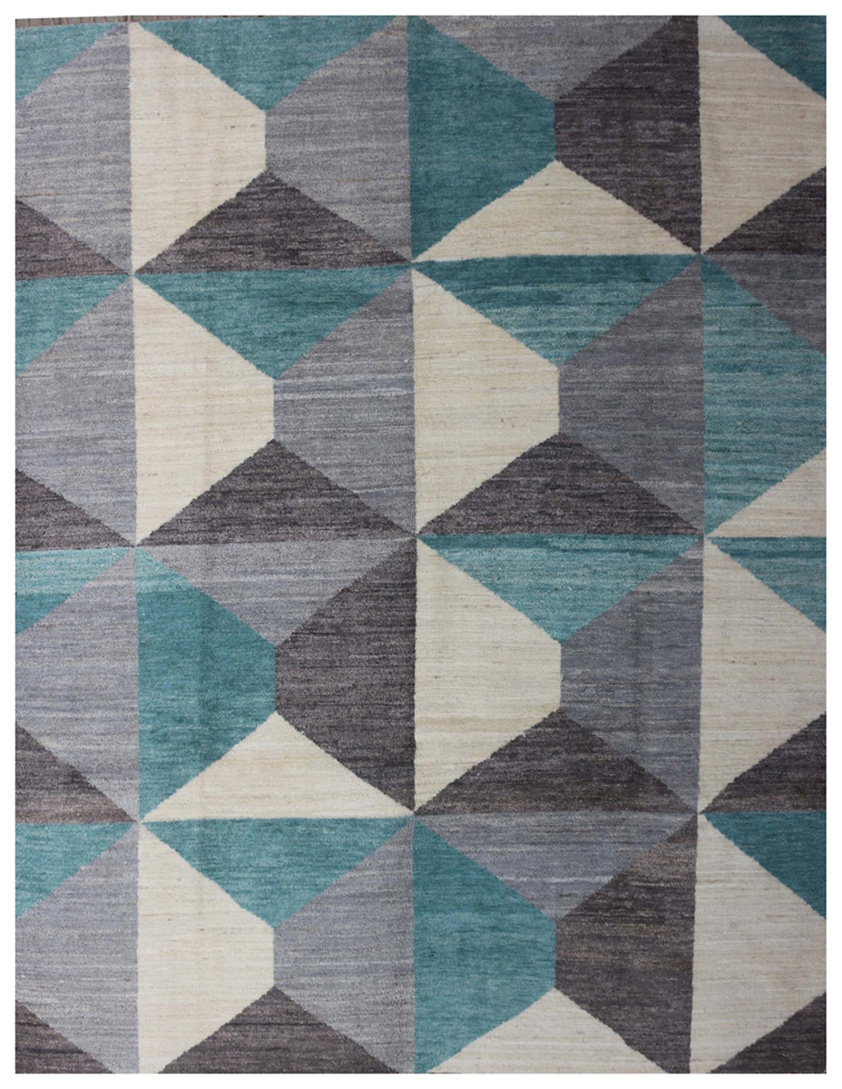
Interlocking polygons give this rug a clear, architectural composition. Teal, cream and several shades of grey meet in angled sections, creating forms that can be read as cubes or folded planes. The colour changes reinforce that three-dimensional impression, while fine variations within each section keep the surfaces from looking completely flat.
This rug would work well with furniture that has simple lines and a limited palette. Cream upholstery could relate to the lightest shapes, while walnut or dark metal would pick up the deeper greys. Its 249 by 310 centimetre proportions would suit a generous living room, where a substantial area of the geometry could remain visible around a table. Within the contemporary Afghan Berber style range, this design gives particular emphasis to enlarged geometric forms. It uses angular divisions and repeated relationships between colours, rather than a small diamond lattice or a central medallion.
The resulting pattern is easy to read across a room, with the same vocabulary continuing to the edges. The teal is distributed throughout the field rather than concentrated in one area. That helps this rug remain balanced beneath an asymmetrical furniture arrangement. At close quarters, the grey sections reveal subtle horizontal changes, adding another level of detail within the larger shapes. Its appeal is especially strong where several polygons meet, as a small change in colour turns a flat geometric arrangement into a convincing suggestion of depth.