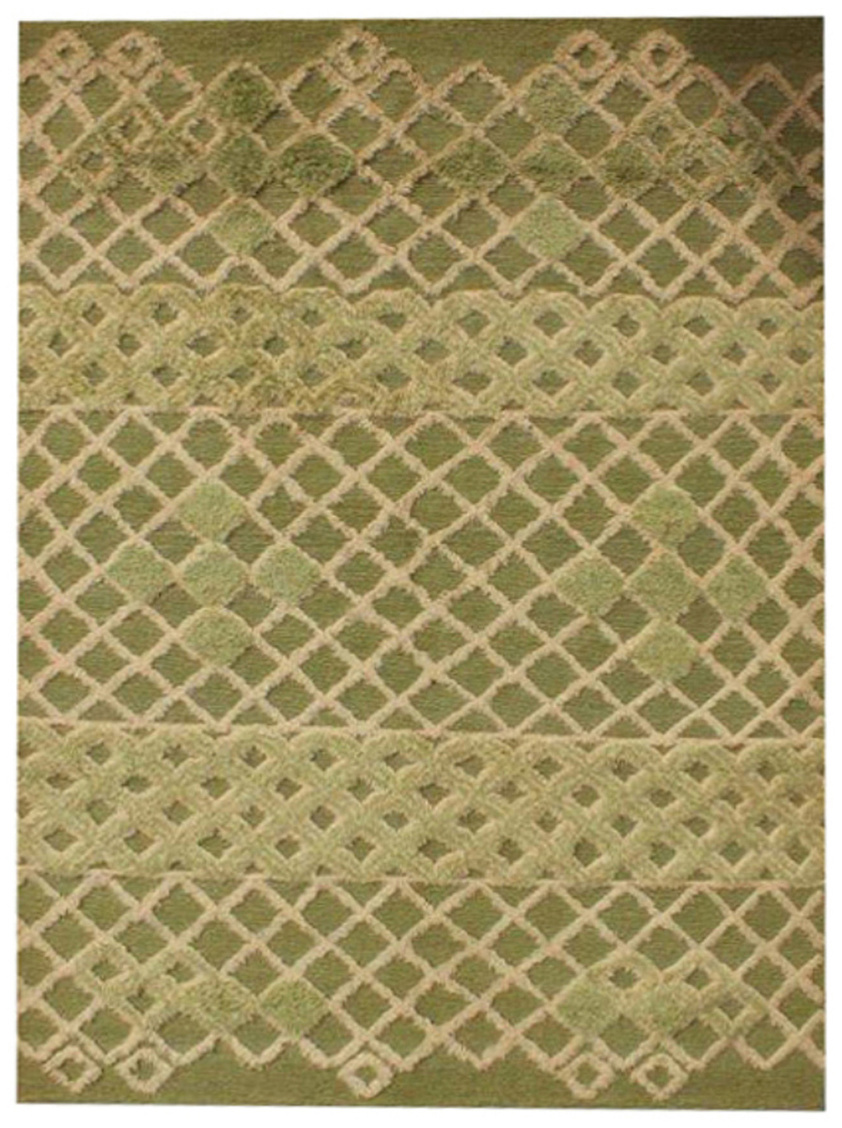
An olive green field gives this rug its distinctive depth of colour. Across it, a fine cream lattice opens into diamonds of slightly varying proportions, with denser bands of linked lozenges interrupting the repeat. These changes in scale keep the surface lively without introducing a separate central medallion. The geometry reaches towards the edges, allowing the green to read as one continuous ground. This rug has a particularly measured balance between drawing and colour.
The pale lines are clear enough to establish the pattern from across a room, while their softer outlines become more apparent at close quarters. Small shifts between green, olive and golden tones give the field a less uniform appearance than a solid colour would provide. Its rectangular proportions suit a compact seating arrangement or the open floor beside a bed.
The Berber reference in this Afghan rug describes a design influence associated with North African weaving, where diamonds, lattices and freely varied geometric forms have a long place in the decorative vocabulary. Here that vocabulary appears in a contemporary Afghan interpretation, with a closely spaced repeat and an unusually rich green ground. Try this rug with oak, walnut or painted furniture, allowing the cream lines to pick up lighter upholstery. Olive also sits comfortably beside warm grey and muted terracotta. A plain sofa would leave the changing diamond bands visible, making this rug the principal patterned surface in the room.