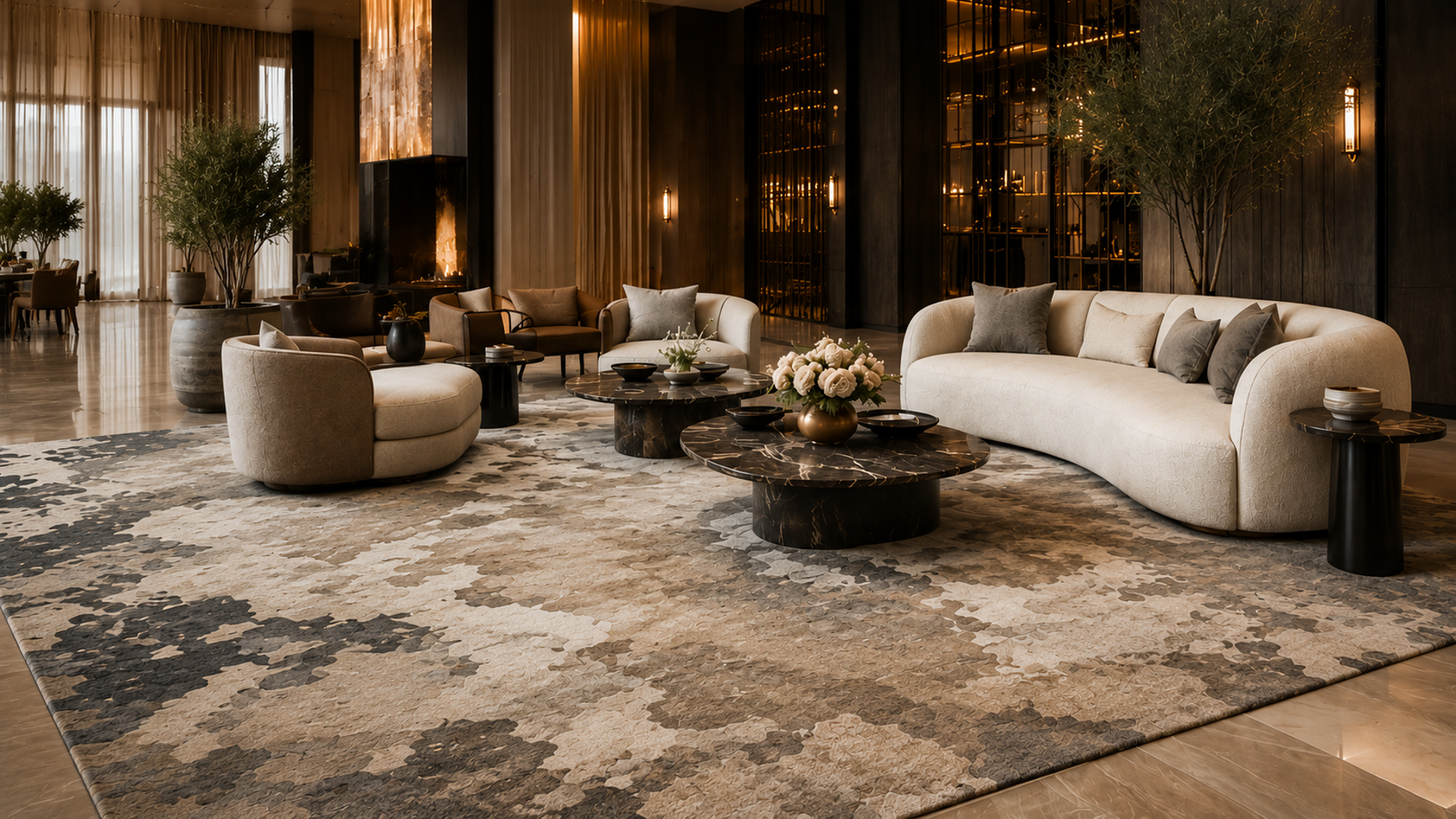
How Global Supply Changes Are Reshaping Bespoke Rug Design in Commercial Interiors
London House Rugs - June 12 2026
Insight, planning and designing beyond borders
The finest interiors have always been shaped by more than aesthetics alone. Behind every beautifully considered hotel lobby, private members' club, luxury residence or hospitality space lies a complex network of artisans, manufacturers, suppliers and craftspeople working together to bring a designer's vision to life.
Few elements embody this relationship between design and craftsmanship more completely than a bespoke handmade rug.
For decades, the process of commissioning a custom rug remained largely unchanged. Designers selected colours, materials and construction methods, manufacturers translated concepts into technical drawings, artisans brought them to life on the loom, and the finished piece was transported to site for installation.
Today, however, the landscape is evolving.
Global supply chains have undergone significant change in recent years, affecting everything from raw materials and manufacturing schedules to freight routes and project lead times. Whilst these shifts have presented challenges, they have also encouraged a more thoughtful and strategic approach to commercial interior design—one that is ultimately producing more considered, sustainable and successful outcomes.
For interior designers, architects and hospitality procurement teams, understanding these changes is becoming an increasingly important part of the specification process.
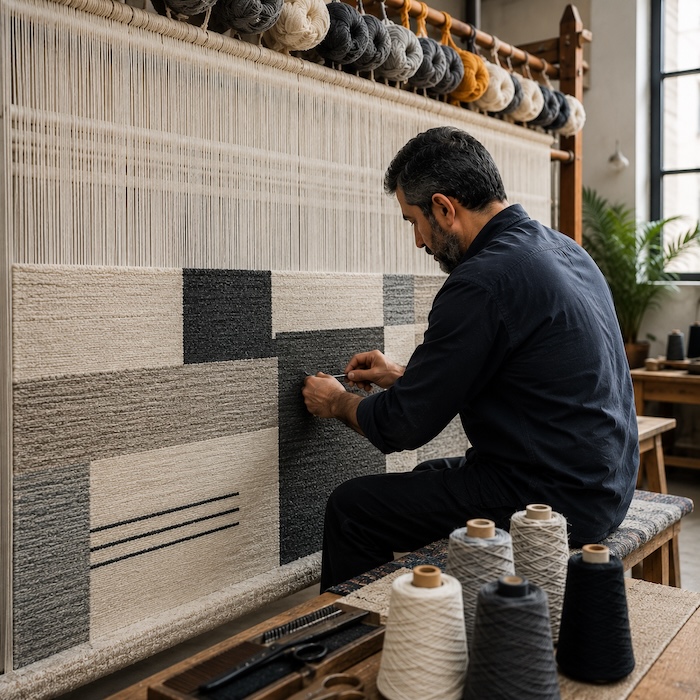

A Truly Global Craft
Unlike many categories of interior furnishings, handmade rugs are the product of highly specialised international craftsmanship.
A bespoke rug may begin with wool sourced from one region, dyed in another, woven by skilled artisans elsewhere, before being washed, finished and transported internationally for installation.
This intricate process has developed over centuries and remains one of the reasons handmade rugs continue to offer an unmatched level of artistry, durability and individuality.
Yet this international nature also means that handmade rug production is closely connected to global logistics.
As international freight networks continue to adapt to changing geopolitical and economic conditions, transportation has become a more significant consideration than ever before.
Why Freight Now Matters Earlier in the Design Process
For many years, transportation was often viewed as a final stage consideration. The rug was produced, approved and then shipped to site.
Today, leading designers are increasingly considering logistics much earlier in the specification process.
The reason is simple.
Handmade rugs are substantial pieces. Large hospitality rugs often weigh hundreds of kilograms and occupy considerable freight volume. Whilst air freight remains appropriate for certain projects, rising transportation costs and evolving shipping routes have encouraged many commercial projects to adopt a more strategic approach.
As a result, early planning has become one of the most valuable tools available to both designers and procurement teams.
By involving rug manufacturers at the concept stage rather than towards the end of a project programme, opportunities often emerge to optimise production schedules, coordinate installations and reduce unnecessary transportation costs without compromising the design itself.
Design Is Adapting—Not Compromising
One of the more interesting outcomes of these changes is that designers are not necessarily simplifying their ambitions. Instead, they are refining them.
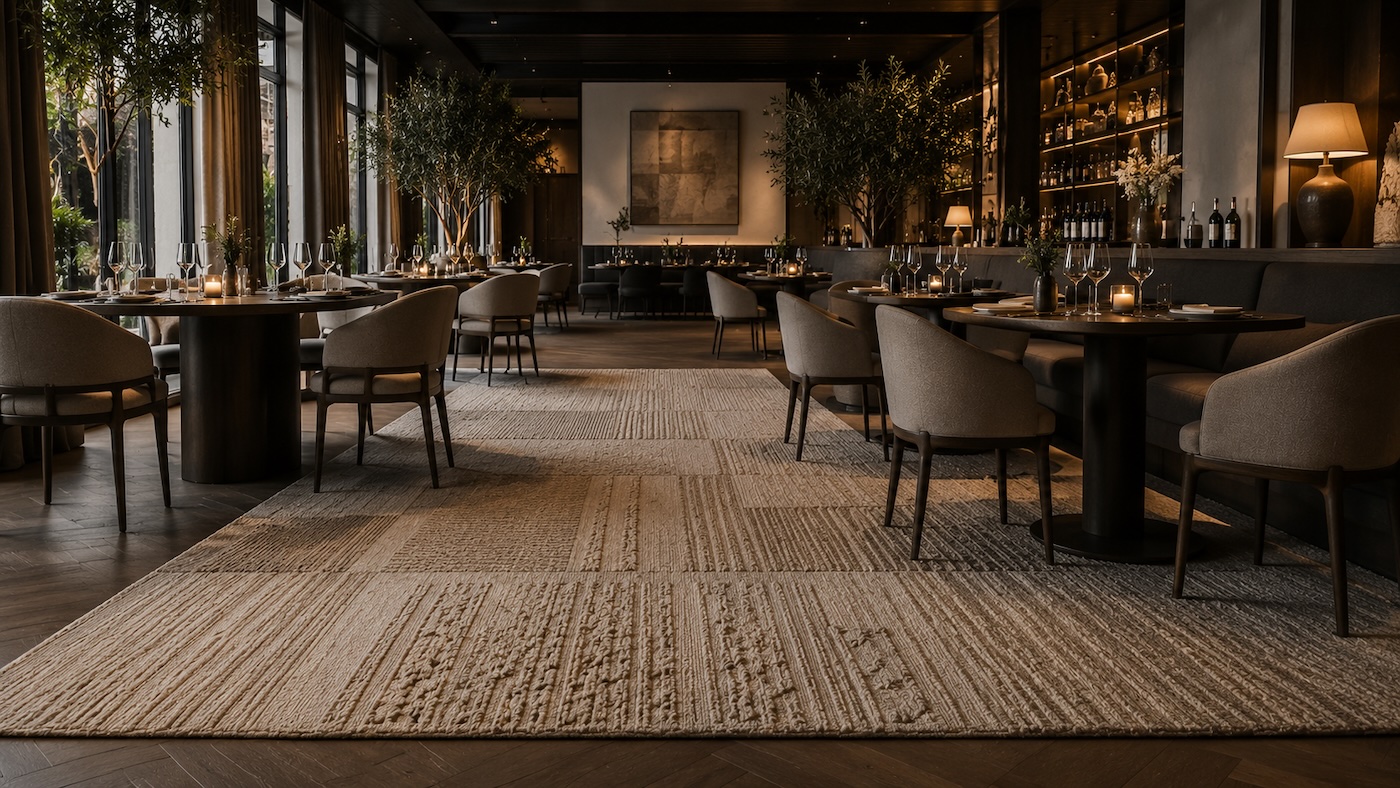
Across hospitality and commercial interiors, there has been a noticeable move towards richly textured surfaces, tonal layering, natural materials and sculptural forms.
These designs often rely less on complex colour palettes and more on subtle variations in texture, pile height and craftsmanship.
The result is an aesthetic that feels sophisticated, contemporary and timeless whilst remaining highly practical for commercial environments.
For luxury hotels and hospitality spaces in particular, handmade rugs are increasingly being used as architectural elements rather than decorative accessories. They define zones within open-plan spaces, improve acoustics, introduce warmth and create a sense of permanence that few other finishes can achieve.
In many respects, current design trends are perfectly aligned with a more considered approach to manufacturing and logistics.
The Value of Thinking Ahead
One lesson that has emerged repeatedly across commercial projects is the importance of early specification.
The sooner a bespoke rug is integrated into the design process, the more flexibility exists around production planning, material selection and transportation options.
This is particularly relevant for larger projects where multiple furnishings are being manufactured simultaneously.
At London House Rugs, we have increasingly worked with designers and procurement teams to coordinate production schedules and consolidate shipments wherever possible. Rather than arranging multiple individual deliveries, grouping completed items into larger shipments can create significant efficiencies across both cost and project management.
For clients, this often provides greater predictability and improved budget control.
For designers, it can reduce the pressure that frequently accompanies compressed installation programmes.

The Rise of Consolidated Shipping and Sea Freight
Perhaps the most significant shift within the handmade rug industry has been the increasing use of consolidated sea freight.
Whilst air freight continues to play an important role for urgent projects, many commercial clients are now embracing sea freight as part of a broader strategy focused on planning, sustainability and operational efficiency.
When incorporated into project schedules from the outset, sea freight can offer substantial advantages.
Beyond reducing transportation costs, it also provides a more environmentally responsible solution and supports the wider movement towards slower, more considered luxury.
For large hospitality projects, where rugs may be commissioned many months before opening, sea freight has become an increasingly attractive option.
Rather than viewing this as a compromise, many designers now see it as an opportunity to create a more organised and sustainable procurement process.
A Practical Design Consideration Few People Discuss
One of the more useful insights to emerge from recent freight changes concerns rug sizing itself.
Whilst bespoke rugs are often designed around architectural dimensions, relatively small adjustments can sometimes have a significant impact on shipping costs.
As a general guideline, rugs measuring around 300cm on one side frequently fall into oversized freight categories, attracting substantially higher transportation charges.
Where design schemes allow, specifying a rug at approximately 290cm rather than 300cm can often reduce shipping costs considerably without creating any meaningful visual difference within the finished interior.
For large-scale commercial projects involving multiple rugs, these seemingly minor dimensional adjustments can contribute to meaningful savings across the overall procurement budget.
It is a small detail, but one that demonstrates how thoughtful specification can influence both design and project economics.
Sustainability Through Better Planning
Sustainability continues to shape procurement decisions across the hospitality and commercial sectors.
Whilst handmade rugs have long been recognised for their longevity, natural materials and repairability, transportation is increasingly becoming part of that sustainability conversation.
Consolidated deliveries and planned sea freight significantly reduce the environmental impact associated with fragmented international shipping.
Combined with the exceptional lifespan of handmade rugs—many of which remain in use for decades—this creates a compelling argument for a more considered approach to procurement.
The future of luxury interiors is unlikely to be defined by speed alone. Increasingly, it will be characterised by quality, longevity and thoughtful planning.
Looking Forward
The role of the bespoke rug within commercial interiors remains as important as ever.
What has changed is the level of collaboration now required to deliver these projects successfully.
Designers, manufacturers and procurement teams are working more closely together than at any point in recent memory, aligning creative ambitions with practical considerations such as logistics, sustainability and project scheduling.
Far from diminishing the value of handmade rugs, these changes are encouraging a more intelligent and sophisticated approach to specification.
For commercial interiors, this is proving to be a positive development.
The most successful projects today are not those that simply respond to changing global conditions. They are those that use them as an opportunity to design more thoughtfully, plan more effectively and create spaces that are not only beautiful, but enduring.