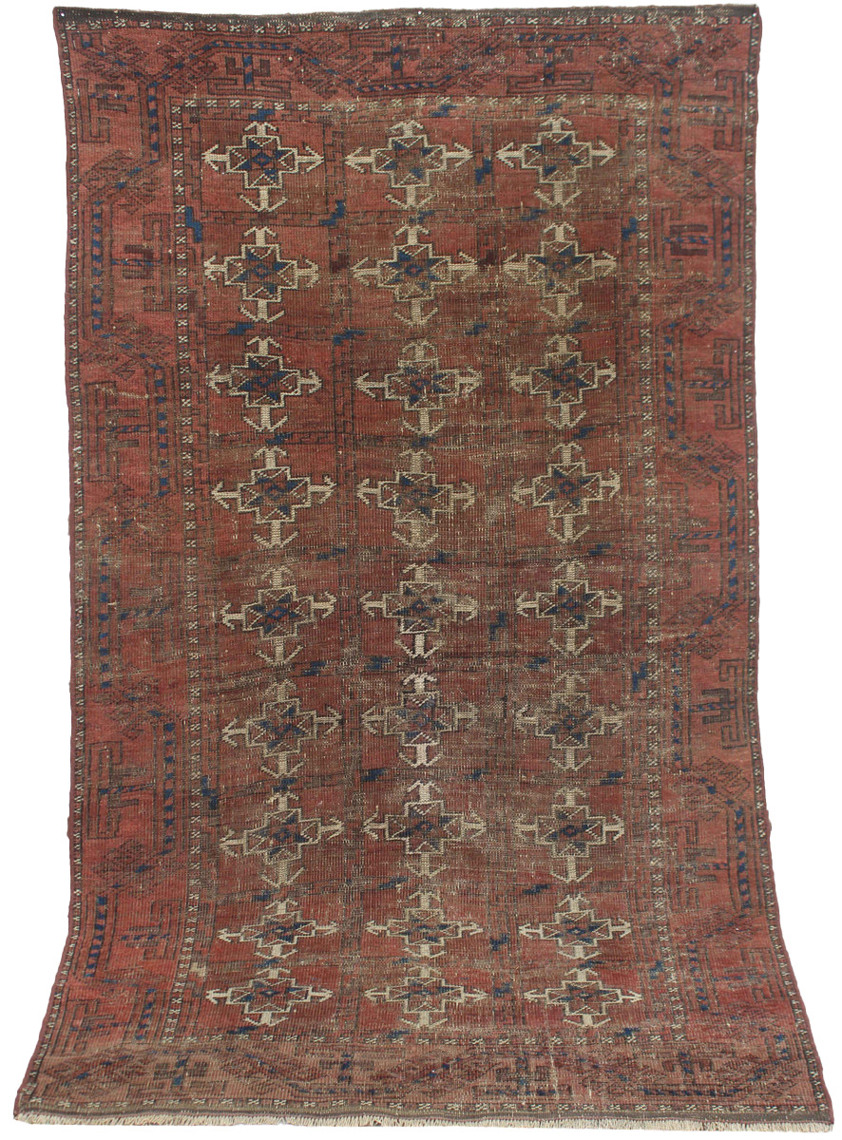
Pale angular guls repeat in columns down the rust-brown field of this rug. Their pointed outlines surround darker centres, with short hooked extensions giving each unit a more complex silhouette. Smaller geometric marks occupy the spaces between them. Fine border bands enclose the field, keeping their colour close to the warm ground. The drawing varies in emphasis across the surface. Some pale points are clearly visible, while nearby internal details sit more quietly within the brown. The fine frame has a closer, more continuous repeat than the larger guls. Near a chair, their little hooked arms and dark centres would offer a detailed view; from farther away, the pale columns would establish the main order within the warm field.
Turkmen weaving has a long Central Asian history, encompassing main floor carpets, bags, tent furnishings and other woven objects. Repeated guls are an important part of its decorative language, developed in many forms among different weaving communities. This antique example uses pale outlines to keep the principal motifs legible within a closely related range of rust and brown tones.
Measuring 182 × 107 cm, this rug could provide a compact elongated accent in a study or beside a bed. Plain cream fabric would refer to the small light details, while warm wood would connect with the ground. A clear middle would make the column arrangement easier to follow from one end to the other.